







What is the story about?
Indian Railways on Tuesday announced five new reforms covering infrastructure projects, ticket cancellations, passenger boarding and freight transport as part of its '52 reforms in 52 weeks' programme.
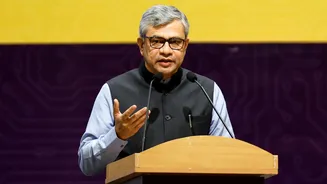
One of the biggest changes is stricter eligibility rules for contractors bidding for railway infrastructure projects. Railway Minister Ashwini Vaishnaw said the move is aimed at ensuring only contractors with relevant experience take up major railway works.
Stricter rules for railway contractors
The Railway Ministry said companies bidding for engineering, procurement and construction (EPC) contracts must now have completed at least 20% of similar work in the past.
It has also fixed bid security at 2% of the project value to simplify the bidding process. For projects worth more than ₹10 crore, contractors' bidding capacity will also be assessed before they are allowed to participate.
The Railways has also changed ticket cancellation and refund rules.
Passengers cancelling a ticket more than 72 hours before departure will now pay only a flat minimum cancellation charge per passenger.
Those cancelling between 72 hours and 24 hours before departure will be charged 25% of the ticket fare. If a ticket is cancelled between 24 hours and eight hours before departure, passengers will get 50% of the fare back. No refund will be available if a ticket is cancelled less than eight hours before the train leaves.
Another passenger-friendly change is that counter tickets can now be cancelled at any railway reservation counter in the country, instead of only at the station where they were booked.
Passengers will also be able to change their boarding station up to 30 minutes before the train departs, replacing the earlier rule that allowed changes only before the reservation chart was prepared.
Freight transport reforms
The Railways also announced the introduction of single-stack and double-stack wagons for transporting automobiles.
Another reform relates to salt transportation. The ministry is introducing stainless steel containers that can be loaded from the top and unloaded from the side. The new system is expected to reduce corrosion, water seepage and handling losses while allowing salt to be loaded directly at production sites and transported more efficiently across different modes of transport.
One of the biggest changes is stricter eligibility rules for contractors bidding for railway infrastructure projects. Railway Minister Ashwini Vaishnaw said the move is aimed at ensuring only contractors with relevant experience take up major railway works.
Stricter rules for railway contractors
The Railway Ministry said companies bidding for engineering, procurement and construction (EPC) contracts must now have completed at least 20% of similar work in the past.
It has also fixed bid security at 2% of the project value to simplify the bidding process. For projects worth more than ₹10 crore, contractors' bidding capacity will also be assessed before they are allowed to participate.
Also
read: Ashwini Vaishnaw unveils Rail Tech Portal, e-RCT as part of railway reforms
Ticket cancellation and refund changesThe Railways has also changed ticket cancellation and refund rules.
Passengers cancelling a ticket more than 72 hours before departure will now pay only a flat minimum cancellation charge per passenger.
Those cancelling between 72 hours and 24 hours before departure will be charged 25% of the ticket fare. If a ticket is cancelled between 24 hours and eight hours before departure, passengers will get 50% of the fare back. No refund will be available if a ticket is cancelled less than eight hours before the train leaves.
Another passenger-friendly change is that counter tickets can now be cancelled at any railway reservation counter in the country, instead of only at the station where they were booked.
Passengers will also be able to change their boarding station up to 30 minutes before the train departs, replacing the earlier rule that allowed changes only before the reservation chart was prepared.
Freight transport reforms
The Railways also announced the introduction of single-stack and double-stack wagons for transporting automobiles.
Another reform relates to salt transportation. The ministry is introducing stainless steel containers that can be loaded from the top and unloaded from the side. The new system is expected to reduce corrosion, water seepage and handling losses while allowing salt to be loaded directly at production sites and transported more efficiently across different modes of transport.