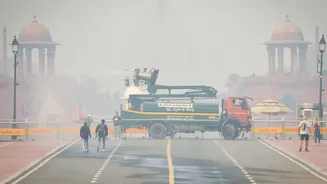

In the Akshardham and Ghazipur areas, the Air Quality Index (AQI) stood at 298, placing both localities firmly in the 'Poor' category. Anand Vihar also reported an AQI of 298, reflecting a similarly deteriorated air quality level.
Morning visuals from India Gate and Kartavya Path showed dense smog hanging low over the iconic stretches, where the AQI was recorded at 225, also categorised as 'poor'.
As pollution levels remain a persistent health concern, Sangita Reddy, Joint Managing Director of Apollo Hospitals, underscored the urgent need for a collective response. "It is a significant aspect that the environment plays a role in healthcare and preventive healthcare. As a country and as a world, we have to understand the impact of the environment. We must come together to take a multi-pronged approach because one thing is not enough," she told news agency ANI.
Delhi's air quality is expected to remain in the 'poor' category through the week, with weather conditions likely to limit dispersion of pollutants.
According to the CPCB, an AQI between 0 and 50 is considered 'good', 51–100 'satisfactory', 101–200 'moderate', 201–300 'poor', 301–400 'very poor' and 401–500 'severe'.
According to the Decision Support System for Delhi’s air quality management, vehicular emissions within the city contributed 17.1 per cent to local pollution on Tuesday, followed by industries in Delhi and surrounding regions at 8.3 per cent, and domestic emissions at 4.1 per cent.
For Wednesday too, the system forecast vehicular emissions to be the prime source of pollutants -- contributing around 17.1 per cent.