

By Andrew Osborn and Maxim Rodionov
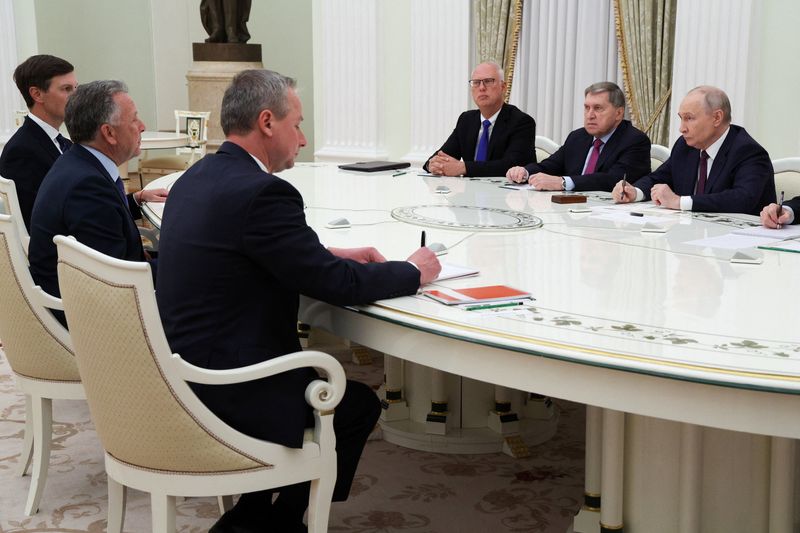
MOSCOW, Nov 12 (Reuters) - President Vladimir Putin agreed on Thursday to let European representatives join the next round of Ukraine peace talks, a US envoy said, though
the Russian leader said Washington must work with its European allies to understand if they want peace or war in Ukraine.
The move to give Europe a seat at the negotiating table at the next round of talks, which US envoy Steve Witkoff told reporters after the talks, is a breakthrough. But Putin's comments underlined how difficult the negotiations could become, given sharp differences between Moscow and European capitals.
"The Europeans will join at the next meeting, which we consider to be a very important moment because they are our partners and it's important to us that they take part," Witkoff told Russian state TV after meeting Putin in the Kremlin.
But in a sign of renewed tensions, Ukrainian President Volodymyr Zelenskiy - who Witkoff and Kushner were expected to meet later in Dublin - said new restrictions were affecting the US-made satellite communications Kyiv uses on the battlefield, and that he found the US approach of discussing a new European security order with Russia "a bit strange".
Zelenskiy voiced alarm after two days of trilateral talks in Abu Dhabi earlier this week at which Kyiv and Moscow said there had been some progress but that major differences remained, including on territorial issues.
"So far we know very little (on the Starshield restrictions). But some things are already clear: if someone in America is making decisions that basically treat Ukrainian territory as if it is not Ukrainian, then it tells us where things are going," said Zelenskiy.
The main outcome of the Abu Dhabi talks, the first direct US-mediated negotiations between Russia and Ukraine in nine months, was agreement on a major exchange of prisoners of war likely to take place in the coming weeks.
Serious unresolved issues remain however, including differences over territory - with Russia holding about one fifth of Ukraine and Kyiv refusing to give up the rest of the Donbas region in its east.
EU ROLE IN TALKS?
Kushner told Putin that Washington had detected what he called "a big change" in the European side and was confident that expanding peace talks to include the Europeans would not hinder progress.
Putin said Moscow had always been open to talking to the EU about Ukraine, but signalled serious outstanding differences.
"As far as the Europeans are concerned, we have never been opposed to engaging in dialogue with Europe, and we have never broken off that dialogue. It was they who broke off the dialogue with the Russian Federation," he said.
He then warned that the European idea of sending Western troops into Ukraine once a peace deal was concluded would trigger a resumption of the war because Russia would see that as a threat to its own security.
"We would very much like you, gentlemen, and the US administration as a whole, to work with your European allies so that they can finally make up their minds as to what they want: peace or war in Ukraine," said Putin.
Zelenskiy said disruptions to the Starshield satellite communications service were significant, affecting the entire front line and Russian-controlled parts of Ukraine. Starshield is the military version of SpaceX's Starlink satellite communications service, and Ukraine suffered similar disruptions last month.
In a post on Telegram, Zelenskiy said that systemic restrictions were limiting the speed at which Starshield could be used. As a result, Ukrainian interceptors could not reach sufficient speed to down Russian jet-powered drones, he said.
PROPOSED AID MISSION
Putin told the US envoys that Russia was proposing a joint Russian-Ukrainian humanitarian mission to Kostiantynivka in eastern Ukraine which he said Moscow controlled, an assertion Ukraine has taken issue with in the past.
Putin said the mission could be modelled on an initiative that allowed residents to leave the Russian-controlled town of Oleshky in southeastern Ukraine at the end of last month and for aid to be brought in for those who chose to remain.
Russia needed five days to clear the area near Kostiantynivka of mines, Putin said, saying there were 400-500 residents of the city who were still there. The mission would allow the world to understand who controlled the city, he added.
Kyiv has previously expressed concerns that Moscow might wish to use ceasefires for such missions so that its military can regroup.
Moscow has not made major territorial gains this year, but has heavily attacked Ukrainian infrastructure and Kyiv has frequently struck Russian oil refineries with drones, causing fuel shortages over the summer, a problem which has resurfaced in some regions this week according to local officials.
Putin has shown no signs of being ready to moderate his territorial demands, which include a buffer zone in parts of Ukraine which Russia has not formally claimed as its own.
(Reporting by Reuters, Writing by Andrew Osborn, Editing by Timothy Heritage)