



By Holger Hansen and Ludwig Burger
BERLIN, Nov 11 (Reuters) - Germany's Council of Economic Experts significantly revised up its growth forecasts for Europe's largest economy on Wednesday, while warning
the government must rein in spending on defence and retirement benefits to get runaway deficits under control.
The five-member panel of independent advisors, whose assessments are closely watched by Berlin, more than doubled its 2026 forecast to 1.3%, and predicts growth of 1% next year.
That is broadly in line with the government's and leading economic institutes' projections and marks an increase from May estimates of 0.5% growth for this year and 0.8% for 2027.
Inflation is also expected to climb to 2.8% this year and 3.3% next year from 2.2% last year.
The more optimistic outlook was due to a quicker-than-expected recovery from the energy shocks created by the Iran war and stronger-than-forecast exports, said council chair Monika Schnitzer.
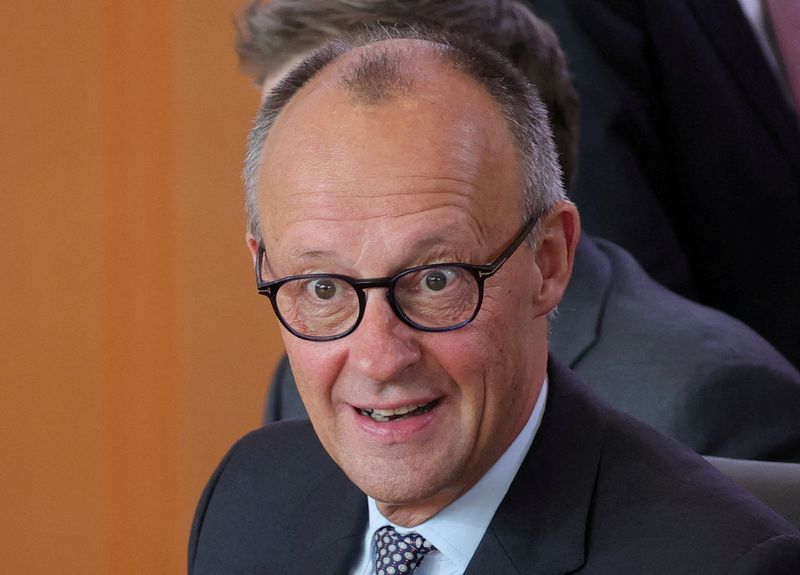
"We are seeing a clear economic upturn, driven by surprisingly strong exports and high levels of government spending," she said, while handing the council's annual report to Chancellor Friedrich Merz at a Wednesday press conference.
Merz said that he had not necessarily expected such a positive revision given the many crises facing Germany.
"These are encouraging signs for businesses, as well as for private households throughout Germany," he said.
Alongside record spending on infrastructure and defence, Merz has pledged structural reforms to safeguard public finances, including an overhaul of the pension system.
POLICYMAKERS WILL FACE 'TOUGH DECISIONS'
However, the council warned that there would be a growing gap in the federal budget that would require even more debt or austerity measures.
The expert panel predicts that the deficit would reach between 2.7% and 4.8% of annual economic output that was not covered by current budgeting projections by 2040.
"Policymakers will be unable to avoid making tough decisions," said Schnitzer, adding that relying solely on additional economic growth to resolve budget issues was not a viable solution.
Mathematically, such an approach would require growth rates "the likes of which we have not seen in the past 50 years".
Merz said that his government was fully aware of the challenges facing the country that require funding and would do everything in its power to maintain its top AAA credit rating.
Finance Minister Lars Klingbeil said at a separate event on Wednesday that cost-cutting measures were already underway, with a previous €34 billion ($38 billion) gap in the 2027 budget now closed. The final details of the 2027 budget will be locked in by the Bundestag lower house of parliament on Thursday.
The council's recommendations include cutting overall subsidies, as well as reversing a law that currently allows employees to retire on a full pension after 45 years of paying into social security accounts.
($1 = 0.8957 euros)
(Reporting by Holger Hansen, Ludwig Burger Christian Kraemer and Miranda Murray, Editing by Linda Pasquini and Alex Richardson)