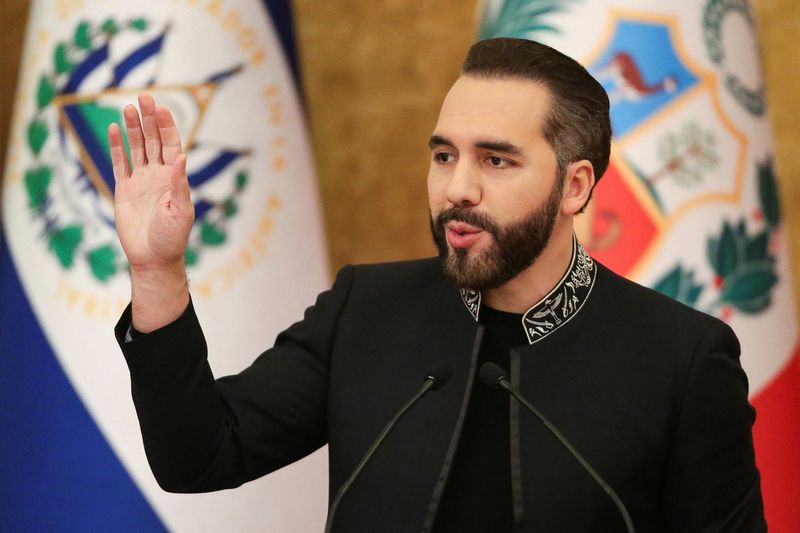




SAN SALVADOR, Nov 19 (Reuters) - El Salvador's Nayib Bukele registered his candidacy on Thursday to seek an unprecedented third term as president in February elections that he is expected to win, even
as critics have raised concerns that his authority is unchecked.
The ruling Nuevas Ideas party has scrapped term limits, a move the opposition and rights groups say will allow Bukele to consolidate power indefinitely without institutional checks and balances. The government has rejected those accusations.
Bukele, 45, now officially running alongside Vice President Felix Ulloa for a third consecutive term, secured his party's nomination in July. He finalized his registration ahead of the Thursday deadline for candidates.
As he arrived to file his paperwork, a crowd of supporters gathered outside the Supreme Electoral Tribunal, cheering and chanting "six more years." After signing his registration, Bukele thanked the crowd and said the country was moving toward a democratic election that would feature "freedom of expression."
After overseeing an aggressive crackdown on organized crime, Bukele is the clear favorite to win the presidential vote. He has support of 55% to 70%, according to polls that also show his party well ahead of opposition parties polling in single digits.
Bukele will face four opposition candidates, including Maytee Iraheta of the right-wing Nationalist Republican Alliance (ARENA) and Rafael Aguirre of the left-wing Farabundo Marti National Liberation Front (FMLN).
While rights groups say Bukele's policies, including a state of emergency imposed in 2022, have harmed due process and innocent lives, the government has dismissed accusations of authoritarianism and said it is prioritizing victims of violence, not gang members.
El Salvador's security crackdown has also boosted Bukele's popularity in the region, with other governments seeking to replicate its model.
In October, El Salvador sent more than 2,000 troops to fight armed gangs in Haiti, in a rare foreign intervention after four Salvadoran members of a UN-backed force went missing. Some analysts said the move, welcomed by Haiti, sought to export Bukele's model regionally.
INCREASING POWER
A former publicist, Bukele was expelled from the FMLN in 2017 and came to power in 2019, ending three decades of rule by ARENA and FMLN.
Two years later, the Supreme Court ruled that sitting presidents could seek reelection, in a break from the Central American nation's past.
Bukele's subsequent landslide election victory in 2024 also handed his party control of Congress, which in 2025 approved a constitutional amendment allowing presidents to run for reelection an indefinite number of times.
The amendment also extended leaders' terms to six years, abolished second-round votes and rescheduled the presidential election to February 2027 to coincide with the legislative and municipal elections.
The two main opposition parties have questioned the mass arrests in Bukele's security crackdown, denouncing many as arbitrary, and have promised to repeal the state of emergency.
The president's Nuevas Ideas party, which holds 54 of the 60 seats in Congress, has said it will also field candidates in the remaining districts, three of which are held by its allies and three by the opposition.
(Reporting by Gerardo Arbaiza; Additional reporting by Diego Oré and Natalia Siniawski; Writing by Coralie Lamarque; Editing by Jonathan Spicer and Tom Hogue)