


By Sarah Morland
MEXICO CITY, Nov 5 (Reuters) - Catholic priests, nuns and deacons across Latin America are turning to social media to reach younger generations as church attendance and religious identity
decline.
The Vatican has embraced social media as a new evangelization frontier. During COVID-19 lockdowns, online religious content surged and many sermons and celebrations moved online.
Content on the short-video app TikTok ranges from reflections and holy water tutorials to comedy and late-night raves. Last year, a trio of Austrian octogenarian nuns leveraged their online clout to avoid eviction and documented their dramatic escape from a church-assigned nursing home.
During his papacy, the late Pope Francis encouraged local churches to support those carrying out missions in the digital realm. While Pope Leo, who is touring South America starting on Friday, has struck a more cautious tone, Catholic summits offering support and media training continue to thrive globally.
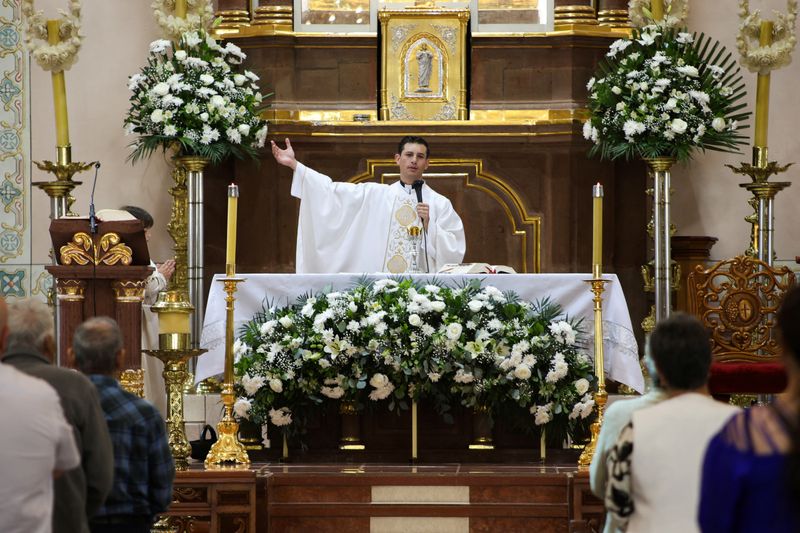
Mexican priest and filmmaker Heriberto Garcia, 38, from Jalisco, believes online pulpits should be seen as a bridge whose ultimate goal is to bring people to religion off screen.
Garcia learned to ride before he could walk. He began posting videos of charreria, a form of Mexican horsemanship and a family passion, before launching into religious reflections aimed at young people struggling with mental health.
His audience grew rapidly during the pandemic. He counts over 2.7 million followers across his platforms, ranging from teenagers to retirees who watch his formal yet intimate sermons filmed in close-up headshots.
"There are a lot of people who don't have a priest, a psychologist, or someone they trust to talk to nearby, but they do have social media," Garcia said in an interview. Despite his success, Garcia said he still feels more comfortable at the pulpit.
Colombian deacon Rafael Beltran is part of a Vatican committee created after the 2024 Synod of Bishops to support digital creators across Latin America. He said shared language and culture help influencers reach beyond borders.
The largely unregulated world of influencing has also made some church leaders wary, he added: "Everyone with a mobile phone can share something about our faith, but criticism has arisen partly because there's a lot of freedom, or lack of control."
DIGITAL MISSIONS
Latin America is home to more Catholics than any other region, according to the Vatican. The religion continues to dominate after a series of sexual abuse scandals and as its traditional teachings have increasingly diverged from some countries' reforms expanding rights for same-sex couples and easing abortion restrictions.
A secular state, Brazil hosts the world's largest Catholic population and the Church remains hugely influential even as evangelical Christianity gains ground.
Progressive Catholics like Carla Angelini, who coordinates the Brazilian branch of Catholics for the Right to Choose, a network that defends abortion rights, said they have a tough time breaking through unfavorable online algorithms.
Social media companies "take down our accounts and censor our content if we talk about abortion," she said, adding that another Catholic group attempted to sue them to change their name. Abortion in Brazil is illegal unless specific conditions can be proven.
Two years ago, lawmakers took 23 seconds to fast-track a bill that would have raised abortion prison sentences nearly sevenfold to up to 20 years — more than double the standard sentence for rape. The bill failed after a mass social media mobilization, including calls to protest from popular Brazilian K-pop fan groups.
This year, an anti-misogyny bill met opposition from lawmakers who argued the law could limit religious teachings. Senators ultimately passed it unanimously.
"We have to think strategically because clearly there are people out there who support our cause," Angelini said. "There are other ways of understanding religion, and our faith empowers us to denounce injustices and advance human rights."
(Reporting by Sarah Morland in Mexico City. Editing by Lucinda Elliott and Rod Nickel)