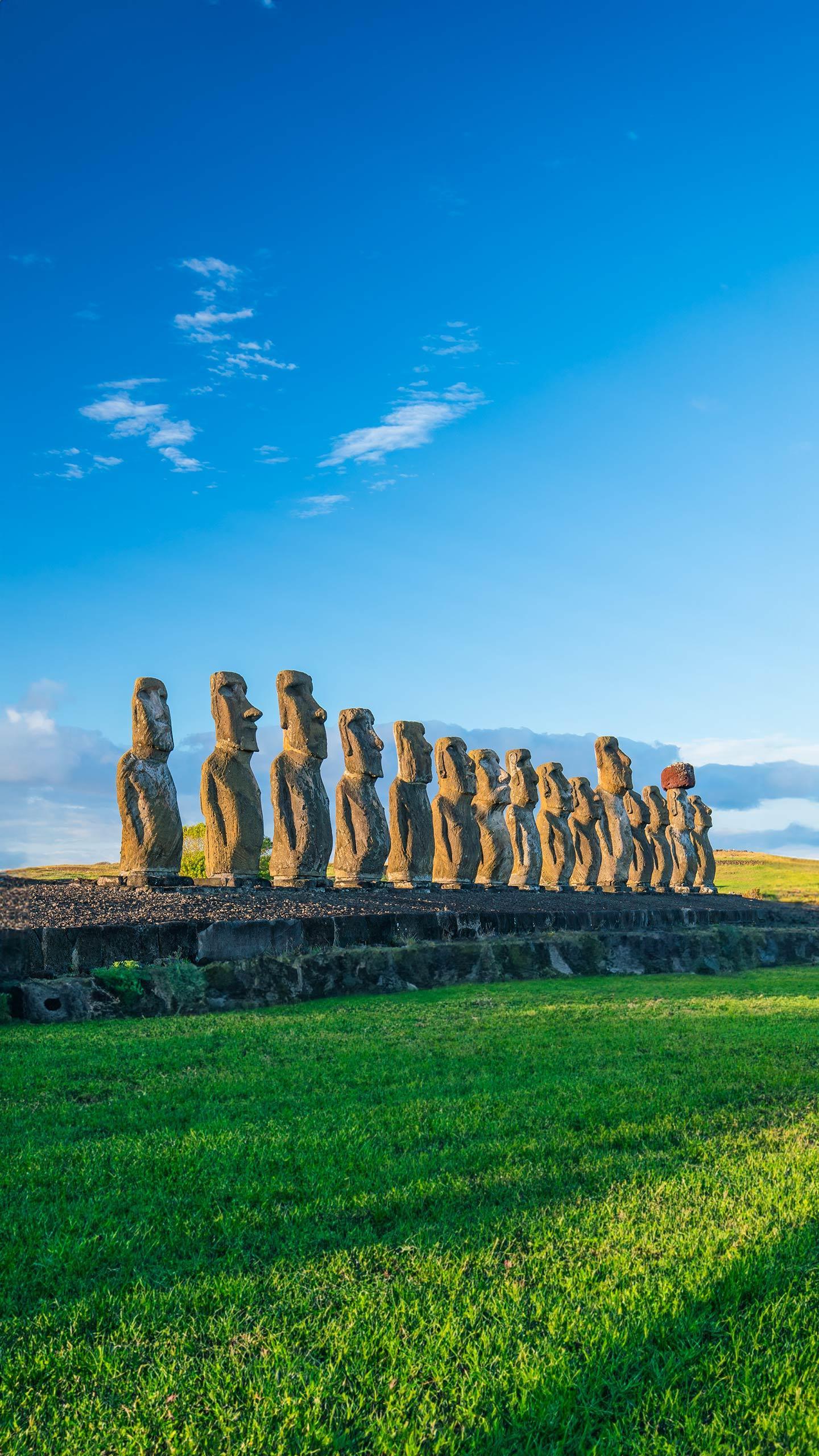



What's Happening?
A new book by British writer and archaeologist Mike Pitts, titled 'Island at the Edge of the World,' challenges the long-held theory that the Rapa Nui people caused their own demise through 'ecocide.'
For decades, the prevailing narrative, popularized by authors like Jared Diamond, suggested that the Rapa Nui overexploited their island's natural resources, leading to deforestation, famine, warfare, and cannibalism. However, Makana Eyre's commentary in Honolulu Civil Beat highlights that scholars have been undermining this hypothesis for nearly 30 years, finding little evidence for reckless deforestation, pre-contact population collapse, catastrophic warfare, or cannibalism. Pitts's book synthesizes recent research and historical sources to offer a revised history, arguing that the Rapa Nui developed sophisticated systems to thrive in their environment. A population collapse did occur, but it followed European contact in 1722, driven by slave raids, disease, and colonial conquest, which reduced the population from about 5,000 to just over 100 in 15 years.
Why It's Important?
This re-evaluation of Rapa Nui's history is significant because it challenges a widely taught 'cautionary tale' that has influenced environmental education and public understanding of ecological responsibility. The original narrative, often presented as an exemplar of 'ecocide,' placed blame on the indigenous population for their own destruction. The revised understanding shifts the focus to the devastating impact of colonialism, disease, and exploitation by European powers. This change in perspective is crucial for understanding historical injustices and for promoting a more accurate and nuanced view of human-environment interactions. It also highlights how narratives can be shaped and perpetuated, sometimes to the detriment of historical truth and the reputation of indigenous communities.
What's Next?
The publication of Pitts's book and the ongoing scholarly debate aim to correct the historical record regarding Rapa Nui. The challenge now is to disseminate this revised understanding to a broader audience, including educational institutions that continue to teach the older, discredited narrative. Makana Eyre suggests that this is an opportune moment to reappraise the story, especially with recent news related to the island. The hope is that this new perspective will unravel the long-followed narrative and begin to undo the harm done to the reputation of the Rapa Nui people, recognizing their resilience and sophisticated environmental management rather than blaming them for a collapse largely instigated by external forces.
Beyond the Headlines
The Rapa Nui case serves as a powerful example of how historical narratives can be constructed and maintained, often reflecting contemporary biases and agendas. The 'ecocide' theory resonated with environmentalists seeking a clear cautionary tale, but it inadvertently blamed the victims of colonial violence and disease. This situation underscores the ethical imperative of historical accuracy and the dangers of simplifying complex historical events to fit a particular moral or political agenda. It also highlights the ongoing struggle for indigenous communities worldwide to reclaim their histories and challenge dominant narratives that often misrepresent or diminish their experiences and achievements. The re-examination of Rapa Nui's past encourages a critical approach to historical accounts and a deeper appreciation for the resilience and ingenuity of indigenous cultures.