




Hair Texture Matters
The foundation of a good braid starts with understanding your hair. Different hair textures require different approaches to achieve optimal results. For
instance, coarse, thick hair often provides a good grip, making braids naturally more secure. The strands tend to hold together better, reducing the chance of the braid unraveling. Fine, silky hair, on the other hand, can be more challenging. It tends to be slippery, making it more prone to slipping out of the braid. In this case, preparing the hair with texturizing products can be helpful. This adds grip and volume, allowing the braid to hold its shape for a longer duration. Before you start braiding, it's beneficial to analyze your hair and decide on the best strategy for success.
Master the Twist
The twisting technique is a fundamental element in achieving a secure and stylish braid. Understanding how to properly twist your hair can make a significant difference in the braid's longevity and appearance. Begin by separating your hair into two sections. Hold one section in each hand. Then, start twisting the sections around each other. Make sure the twist is tight, but not so tight that it strains your hair. As you continue twisting, work your way down the length of your hair. Ensure each twist is consistent in tension to maintain a uniform braid. When you reach the end, secure the twist with an elastic band or a similar fastener. Practicing this technique will improve the quality of your braids considerably.
Sectioning Your Hair
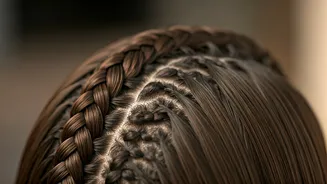
Proper sectioning is critical in making any braid look neat and maintain its structure. Divide your hair into even sections. This ensures each part of the braid is proportionate and contributes to the overall symmetry. The way you section depends on the style of braid you’re creating. For a classic three-strand braid, you'll divide your hair into three equal sections. For more complex braids, such as French braids or Dutch braids, the sectioning becomes a bit more intricate. You'll need to continuously pick up small sections of hair from the sides as you braid. When sectioning, always use a comb or your fingers to create clean partings. This will give you more control and create a polished look. Even sections make the braiding easier to manage and results in a neater, more professional-looking finish.
Half-Up Rope Braids
Rope braids are a stylish variation that's relatively simple. Start by separating a section of hair from the top of your head, the amount depending on the thickness you prefer for the braid. Next, divide this section into two equal parts. Twist the two sections around each other, ensuring they are tightly twisted. This twisting motion gives the braid its distinctive rope-like appearance. As you twist the two sections, hold the ends firmly to maintain the tension and prevent the braid from unraveling. Once you reach the end of the sections, secure the rope braid with a hair tie or small elastic band. The half-up rope braid is a great style for adding detail to your look without the need to braid the whole head.