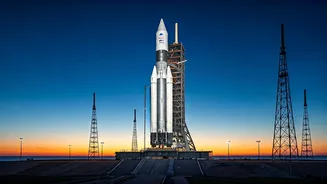







SpaceX Crew 10 Docks
The SpaceX Crew 10 mission has successfully docked with the International Space Station (ISS), bringing four new individuals aboard. The launch was expedited
with the primary goal of facilitating the swift return of astronauts Sunita Williams and Barry "Butch" Wilmore. Prior to this, Sunita Williams had relinquished command of the orbital outpost to Roscosmos Cosmonaut Alexey Ovchinin, marking a significant handover in station operations and a step towards the crew's journey back to Earth.
Astronauts' Extended Stay
NASA's plans to bring astronauts Butch Wilmore and Sunita Williams home encountered further complications when the Crew-10 mission launch was aborted due to a hydraulic issue. This delay extended their stay in space, which had already been prolonged for nine months due to issues with Boeing's Starliner spacecraft. The situation pushed their return date to no earlier than March 17th and ignited political discussions, with figures like Donald Trump and Elon Musk urging NASA towards a more rapid resolution to the astronauts' predicament.
New NASA Missions Launched
NASA has successfully launched two significant missions, the SPHEREx space telescope and the PUNCH solar probes, aboard a SpaceX Falcon 9 rocket. The SPHEREx observatory is designed to create a comprehensive map of the universe by observing light in the infrared spectrum. Concurrently, the PUNCH mission aims to study the Sun's corona and the solar wind, crucial for understanding space weather. These combined efforts promise to deepen our understanding of the cosmos and improve our ability to predict and mitigate solar-related disturbances.
Starship Test Flight
SpaceX's latest Starship test flight concluded prematurely with an mid-air explosion, representing the second major failure for the spacecraft this year. Debris from the incident was observed falling across Florida and the Bahamas, leading the FAA to temporarily halt air traffic at four regional airports. Despite this setback, SpaceX has acknowledged the event while maintaining confidence in their ability to enhance Starship's reliability. This explosion raises questions about the future progression of SpaceX's ambitious lunar and Martian exploration objectives.
Lunar Landing Achievements
Firefly Aerospace has shared footage of its Blue Ghost Moon landing, showcasing the deorbit burn and controlled descent onto the lunar surface. This marks a significant achievement as Blue Ghost is the first privately developed mission to achieve an upright landing on the Moon. The mission aims to conduct various scientific observations and test new technologies on the lunar regolith. The company has stated its intention to operate the lander for a full lunar day, gathering valuable data for future missions.
Extended Space Stays and Alternative Return
NASA astronauts Suni Williams and Butch Wilmore faced an extended stay in orbit, significantly beyond their planned eight-day mission aboard Boeing's Starliner. Technical malfunctions, including thruster issues and helium leaks, prevented their planned return. Consequently, NASA opted to utilize a SpaceX Dragon capsule for their eventual journey back to Earth, highlighting the complexities and challenges of human spaceflight and the reliance on multiple launch providers for mission success and crew safety.
Encephalitis as Health Priority
The World Health Organization (WHO) has designated encephalitis, an inflammation of brain tissue, as a critical public health priority. This condition, caused by a variety of pathogens including viruses, bacteria, and fungi, necessitates immediate medical intervention to prevent potentially severe and lasting neurological damage. The WHO's first technical report on the disease aims to provide comprehensive guidance and promote global efforts for its management and prevention.
Blue Ghost's Lunar Surface Operations
Following its successful touchdown on the Moon, Firefly Aerospace's Blue Ghost lander has begun transmitting valuable observations, including images from the lunar surface. This data is crucial for understanding the Moon's environment and supporting future space exploration initiatives. The mission's success demonstrates the growing capability of private companies in lunar exploration and their role in advancing NASA's Artemis program.
Firefly Aerospace's Lunar Success
Firefly Aerospace's Blue Ghost Moon lander has successfully executed a controlled soft landing on the lunar surface. The spacecraft's retrothrusters managed a descent rate of one meter per second near a volcanic feature on the Moon's near side. Upon contact with the surface, shock-absorbing legs signaled the engines to shut down, confirming a safe arrival and marking a significant milestone for commercial lunar missions.
Interference with Spacecraft Communication
A cell phone tower situated near ISRO's ISTRAC facility in Bengaluru has reportedly caused disruptions to deep space network communications. This interference has impacted several spacecraft, including an asteroid mining mission that is currently struggling with connectivity. The incident underscores the growing challenge of managing electromagnetic interference in increasingly congested terrestrial and near-Earth environments for sensitive space operations.