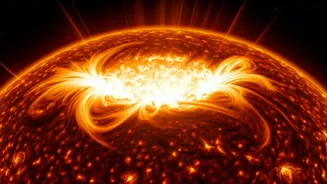








Peering into the Sun
An international consortium of researchers has embarked on an extraordinary journey into the Sun's inner realms, leveraging a quarter-century of continuous
data. Their method, known as helioseismology, involves meticulously tracking the subtle tremors and wave patterns that ripple across the Sun's visible surface. These oscillations act as a kind of seismic echo, providing invaluable clues about the physical conditions and processes occurring far beneath the photosphere. The focus of this extensive investigation was a remarkably thin stratum situated approximately 200,000 kilometers below the surface. This region, referred to as the tachocline, experiences scorching temperatures around two million degrees Celsius. It is within this dynamic layer that distinct rotational patterns of the solar plasma converge and diverge, a phenomenon critically linked to the Sun's capacity to generate its powerful magnetic field and the recurring, approximately 11-year cycle of solar activity.
Precision in the Depths
Achieving an unparalleled level of accuracy in characterizing the tachocline, a long-standing enigma in solar physics, was the primary triumph of this endeavor. To accomplish this remarkable feat, the scientists ingeniously integrated data from multiple formidable sources. This included continuous observations from the ground-based GONG network, renowned for its global coverage, alongside data meticulously collected by space-based observatories such as the Solar and Heliophysics Observatory (SOHO) and the Solar Dynamics Observatory (SDO). The sheer volume of information necessitated the development of novel computational techniques, specifically engineered to process and analyze these vast datasets efficiently. These innovative methodologies were instrumental in enhancing the resolution of the findings, allowing for sharper insights into the tachocline's structure, all while effectively mitigating the impact of background noise and ensuring the reliability of the results.
A More Complex Sun
The implications of this research extend significantly to our understanding of space weather, which encompasses the Sun's impact on Earth. The tachocline plays a pivotal role in the generation of solar magnetism, the very force behind phenomena like solar flares and coronal mass ejections that can erupt from the Sun's surface. The study's revelations indicate a surprising complexity within the Sun's interior. Specifically, the tachocline exhibits a noticeable discontinuity in its position when comparing low and high latitudes. This discovery challenges previous assumptions, suggesting that the Sun's internal structure is far more intricate than previously modeled. Furthermore, the research precisely delineates the tachocline's extent, revealing it to be less than a mere one percent of the Sun's total radius, a surprisingly confined yet critically important region.