







Penguins Beyond Antarctica
World Penguin Day serves as a wonderful reminder that these charismatic birds are not solely inhabitants of the Antarctic continent. They have established
populations across a surprising variety of global locales, each offering a unique opportunity for observation. From the shores of Australia to the volcanic islands near the equator, penguins have adapted to diverse climates and ecosystems. This widespread presence allows travelers to engage with wildlife in meaningful ways, showcasing the resilience and adaptability of these flightless seabirds. Each region presents distinct ecological conditions, influencing penguin behavior and the viewing experience, while also underscoring the critical need for conservation efforts worldwide to protect these species against environmental challenges.
Australian Penguin Shores
Australia's southern coastlines are home to the world's smallest penguin species. Phillip Island in Victoria is a particularly renowned destination, boasting significant colonies where visitors can witness the charming spectacle of penguins returning to shore at dusk. This provides an accessible and memorable wildlife encounter. Other notable locations for penguin sightings include St Kilda Pier in Melbourne, Penguin Island in Western Australia, various sites across Tasmania, and Granite Island Recreation Park in South Australia. The prime viewing season generally spans from September through June, offering ample opportunity for enthusiasts to observe these charming creatures along the Australian coast.
Argentina's Penguin Havens
Argentina's coastal regions are a vital sanctuary for one of the largest populations of Magellanic penguins, with Punta Tombo in the Chubut Province being a standout location. This reserve features extensive breeding grounds where thousands of penguins gather for seasonal nesting activities. Beyond Punta Tombo, travelers can also seek out penguins on Martillo Island near Ushuaia, at Cabo Dos Bahías close to Camarones, and on the San Lorenzo Peninsula within the Valdes Peninsula. The optimal period for visiting these penguin-rich areas is from September to March, aligning with their active breeding and nesting cycles, offering a robust display of their natural behaviors.
Falkland Islands' Diversity
The Falkland Islands offer a unique advantage for penguin enthusiasts, as they host an impressive diversity of five different penguin species in a single archipelago. The rugged coastlines and sandy beaches provide excellent nesting habitats, supporting large and active colonies. Key viewing spots include Volunteer Point on East Falkland, the popular Gypsy Cove and Yorke Bay, Bertha's Beach also on East Falkland, and the wildlife-rich Sea Lion Island and Saunders Island. Observing these penguins can be facilitated through guided tours, cruise excursions, or simply by enjoying walks and hikes along the stunning coastal trails. The best time to visit is between October and March, when the penguin colonies are most active.
Galapagos' Equatorial Penguins
Remarkably, the Galapagos Islands are home to the Galapagos penguin, the only species found so close to the equator. These birds have uniquely adapted to thrive in this tropical environment, benefiting from the cooling influence of ocean currents like the Humboldt Current. This makes the Galapagos a truly distinctive destination for wildlife tourism. Prime viewing locations include the western parts of Isabela and Fernandina islands, such as Tagus Cove, Punta Vicente Roca, and Elizabeth Bay, as well as Bartolomé Island near Pinnacle Rock, Tintoreras Islet on Isabela, and parts of Santiago Island and Floreana Island. Visitors can often see them via cruise excursions, snorkeling trips, or Zodiac boat rides, with the best viewing opportunities generally occurring from June to December.
New Zealand's Penguin Coastline
New Zealand's South Island and its surrounding maritime territories are significant habitats for several penguin species, including the elusive yellow-eyed penguin. This region boasts a captivating blend of picturesque coastlines and a strong emphasis on conservation, offering visitors a chance to observe penguins responsibly. Popular penguin spotting areas include Oamaru in North Otago, the broader Dunedin and Otago Peninsula region, Banks Peninsula near Akaroa, Stewart Island, and the Fiordland area on the West Coast. Sightings are often best enjoyed at sunset, and guided tours can enhance the experience. The advantage of New Zealand is that penguins can be observed year-round, making it a consistently accessible destination.
South Africa's Accessible Colonies
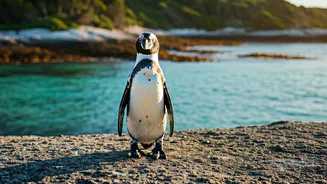
Near Cape Town, South Africa, offers accessible opportunities to see African penguins on mainland beaches. These colonies have become accustomed to human presence, facilitating more convenient sightings for travelers. Boulders Beach in Simon's Town is perhaps the most famous site, with other notable locations including Stony Point Nature Reserve in Betty's Bay, Robben Island and Dyer Island near Gansbaai, and St Croix Island off the coast of Port Elizabeth. Boat tours are a common and effective way to observe these penguins. Unlike some other destinations, South Africa provides year-round viewing opportunities for its resident African penguin populations, making it a reliable choice for wildlife enthusiasts.