
Hidden Himalayan Jewel
Shaksgam Valley, tucked away in the Karakoram Range, is a testament to the Earth's raw power and untamed beauty. Its location is a significant factor in shaping
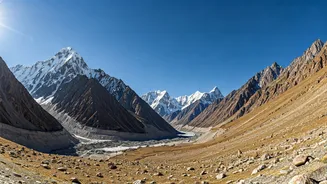
its destiny. Nestled in the disputed territory claimed by both India and Pakistan, the valley presents a complex interplay of geography and geopolitics. The valley's terrain is characterized by towering peaks, massive glaciers, and winding rivers. The rugged landscape itself contributes to its isolation, making it difficult for outsiders to access and explore. Its remoteness has, for the most part, preserved the valley's pristine environment, creating a unique ecological niche. This isolated haven is a powerful reminder of nature’s ability to create pockets of breathtaking beauty far from the bustling world. The valley's story is one of natural majesty and the intricate dance of borders and access.
Geopolitical Boundaries Shape
The political realities surrounding Shaksgam Valley play a critical role in determining who can access this area. The valley sits in a region that has been subject to territorial disputes. Control over this area is contested. The history of the region is laced with conflict and negotiation, which has led to strict access regulations. Both India and Pakistan, along with other regional powers, have complex claims. These issues have created barriers to unrestricted movement and exploration. For Indian citizens, access is almost entirely forbidden, primarily due to the ongoing territorial disputes and security concerns. These restrictions highlight the complex interplay between geography, politics, and the natural world, all converging in this isolated valley. This geopolitical sensitivity continues to shape the valley's destiny and access for the foreseeable future, adding layers of intrigue to its already fascinating story.
The Access Complexities Explained
The reasons behind the limited access to Shaksgam Valley are multifaceted. The area is difficult to reach, with challenging terrain, extreme weather conditions, and high altitude creating formidable hurdles for travelers. Furthermore, the region’s sensitive political status demands that authorities maintain strict control over entry and activity. Security is another key factor; with a history of conflicts in the surrounding areas, restrictions are considered essential for maintaining safety and preventing potential instability. All these factors combine to create a perfect storm of restriction, making Shaksgam Valley one of the world's most inaccessible locations. While the valley might captivate adventurers and explorers, the reality is that the geopolitical and logistical obstacles prevent widespread exploration and access. These challenges make it a prized destination for those few who can navigate its complex conditions and obtain permission.
Why India's Restrictions Exist
For Indian citizens specifically, the limitations on accessing Shaksgam Valley are tied closely to India's territorial claims and the ongoing border disputes. The valley is located in a region that India asserts as its own. Any activity within the area is thus closely monitored and regulated to uphold national interests and security. Furthermore, permitting Indian citizens to freely travel to the valley could be seen as an endorsement of contested claims, which carries profound political implications. These restrictions underscore the government's stance on border issues and its efforts to manage sensitive geopolitical issues. The restrictions not only limit personal travel but also serve as a reminder of the intricate nature of international relations and territorial sovereignty. These policies create a unique situation where a spectacular landscape remains out of bounds, illustrating how politics and geography shape the world.
A Future Outlook
The future of Shaksgam Valley, like that of many remote and contested regions, is shaped by many different factors. Any potential shifts in access are highly dependent on the outcomes of ongoing political negotiations and the evolution of international relations. The environmental concerns regarding the Karakoram region are critical too; responsible tourism policies could play a significant role if access becomes possible, ensuring the area’s delicate ecosystem is preserved. Advances in technology, particularly in navigation and infrastructure, could slowly affect how accessible the valley becomes. However, any developments will likely proceed cautiously, considering the region's geopolitical sensitivity. The ability to visit this incredible destination will depend on political decisions, but also on the willingness to manage its fragile natural environment. The story of Shaksgam Valley remains open, offering opportunities for exploration and stewardship.