




The Art of Movement
Parkour and wall climbing are captivating disciplines that push the boundaries of physical capability, particularly in their impact on balance and agility.
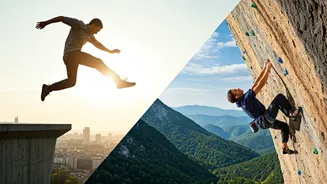
While both activities are demanding and rewarding, they employ fundamentally different approaches to movement and environmental interaction. Understanding these core differences is key for anyone looking to select an activity that resonates with their personal fitness aspirations. This exploration delves into the specific contributions of parkour and wall climbing to developing superior balance, highlighting their individual strengths in the realm of physical conditioning.
Parkour's Dynamic Flow
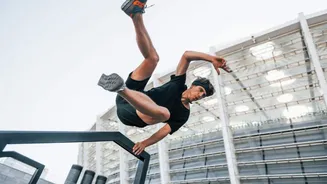
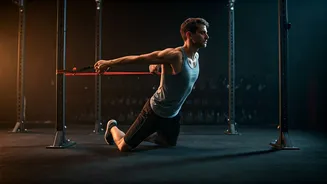
Parkour thrives on a continuous stream of dynamic actions, including fluid jumps, controlled rolls, and efficient vaults over a variety of obstacles. These maneuvers demand a sophisticated level of coordination and a finely tuned sense of balance, especially as practitioners navigate uneven terrains and make sudden directional shifts. The inherent requirement to constantly adapt to new and unpredictable challenges significantly hones proprioception—the body's intrinsic awareness of its spatial positioning. Over time, this continuous adaptation leads to a marked improvement in overall balance proficiency and responsiveness.
Wall Climbing's Static Control
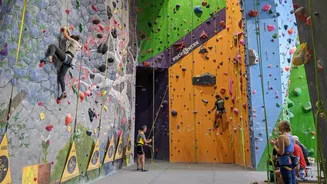
In contrast, wall climbing centers on maintaining stable holds and executing deliberate, precise movements across vertical planes. Climbers must expertly manage their center of gravity while strategically reaching for handholds positioned at varying elevations. This activity places a premium on developing robust core strength and unwavering stability, essential for counteracting the constant pull of gravity. The structured nature of wall climbing provides a controlled setting that allows for concentrated practice of specific balance techniques and isometric strength development.
Navigating Environments
A hallmark of parkour is its profound emphasis on environmental adaptability. Participants develop the skill to modify their actions in real-time based on the specific terrain they encounter, whether it's the concrete jungle of a city or the natural contours of a park or forest. This constant need for adaptation cultivates rapid decision-making under pressure, thereby boosting both mental acuity and physical balance as individuals discover the most effective ways to traverse each distinct setting. This fosters an intuitive understanding of physics and body mechanics.
Precision on the Wall
Wall climbing, conversely, necessitates meticulous precision with every single movement made as climbers ascend both natural rock faces and artificial climbing structures, whether they are situated indoors or outdoors. Each decision a climber makes—from grip selection to foot placement—directly influences their progression and the ultimate success of their climb. This intense focus sharpens concentration levels significantly, a critical attribute when maintaining balance in precarious positions high above the ground after considerable exertion.