




Peak Illumination Details
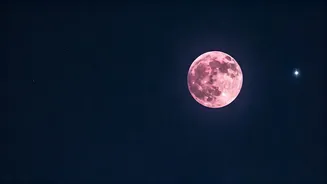
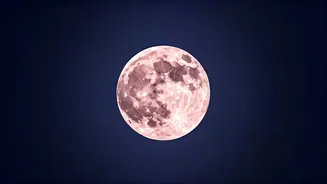
Prepare for the celestial spectacle of April's full moon, often referred to as the Pink Moon, which will achieve its zenith of illumination on April 1,
2026, at 10:11 p.m. EDT. For those observing in India, this translates to the early dawn hours of April 2. This particular lunar event is noteworthy as it falls on April Fool's Day in 2026, adding a playful temporal coincidence to the astronomical occurrence. While the name might conjure images of a rosy-hued orb, the Pink Moon does not, in reality, display a pink coloration. The appellation originates not from its appearance but from the blooming of a specific springtime wildflower, known scientifically as 'Phlox subulata.'
The Pink Moon's Name
The captivating moniker 'Pink Moon' is not a reflection of the moon's actual color but rather a nod to the natural world that awakens with the arrival of spring. This seasonal name is derived from the vibrant blossoms of 'Phlox subulata,' a common wildflower. This plant, also recognized as creeping phlox or 'moss pink,' unfurls its colorful petals during the early spring months, particularly in North America, painting the landscape with its characteristic hues. Therefore, the moon's name serves as an indirect marker of the changing seasons and the re-emergence of life, rather than a literal description of its appearance.
Alternative Moon Names
Beyond its widely recognized designation as the Pink Moon, the full moon occurring in April is known by several other traditional titles. These names often reflect the agricultural cycles and seasonal transformations characteristic of this time of year. Among these alternative appellations are the 'Sprouting Grass Moon,' which signifies the renewed growth of vegetation, and the 'Egg Moon,' potentially linked to the nesting and egg-laying activities of birds during spring. The 'Fish Moon' is another traditional name, possibly referencing the increased abundance or migration of fish in waterways as the weather warms. These varied names offer a glimpse into how ancient cultures observed and interpreted the lunar cycle in conjunction with the rhythms of nature.
Viewing the Lunar Display
For those eager to witness the brilliance of April's full moon, the spectacle will extend beyond its peak illumination. The moon is expected to appear notably bright and nearly full for approximately 24 hours both before and after its official peak, meaning it will be a captivating sight from March 31 through April 2. The most visually impressive time to observe the moon is during its rise at sunset. When the moon is low on the horizon, it often appears larger and more dramatic due to a fascinating optical effect known as the 'Moon illusion.' This phenomenon causes our perception of the moon's size to increase when it is juxtaposed against terrestrial objects or the landscape at the horizon, compared to when it is higher in the vast expanse of the night sky.
Supermoon Status & Significance
It is important to note that despite its striking appearance and the common perception of it being larger near the horizon, April's full moon is not classified as a supermoon. A supermoon occurs when a full moon coincides with its closest point to Earth in its elliptical orbit, resulting in a noticeably larger and brighter celestial body. Nevertheless, the visual splendor and precise timing of the Pink Full Moon make it a significant astronomical event. It serves as a powerful symbol of spring's arrival and plays a crucial role in the ecclesiastical calendar, as its occurrence dictates the date of Easter, which is celebrated on the first Sunday following this particular full moon.