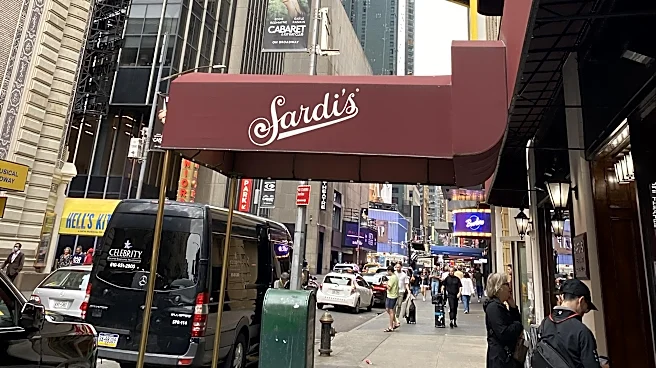










Today, Wednesday, June 24, is the last day the famous Broadway restaurant Sardi’s will run as an independently owned restaurant, the New York Times reported in March. The Theater District institution has weathered the two-year pandemic closure, a bankruptcy,
the fiscal crisis of the 1970s, and the Great Depression: Now, after nearly a century in business, ownership is passing from restaurateur Max Klimavicius to the Shubert Organization, the Broadway group that has owned the building since Vincent Sardi Sr. and his wife, Eugenia, opened the restaurant in the 1920s. (The organization owns 17 Broadway theaters.)
After tonight, Sardi’s will close for several months of renovations: The restaurant will keep its name, its walls of celebrity caricatures, and much of its historic dining room. Klimavicius said the more than 1,000 caricatures — appraised at $6.9 million in 2020 — will be placed in temporary storage during construction and returned afterward. Robert E. Wankel, chairman and CEO of the Shubert Organization, also told the New York Times that a new restaurateur will take over operations, meaning that the menu could change.
“For me, this wasn’t about the money,” Klimavicius, 71, told the publication about his decision to sell to the Shubert Organization. “It was about the continuity of this legacy, so important to me. This has been my life.”
For Klimavicius, it began in 1974, when he arrived in New York from Colombia and was hired to work at Sardi’s as a kitchen assistant. Over the decades, he worked his way up from table captain to maître d’ to management, and then became a partner with Vincent Sardi Jr. in 1991. He later bought the remaining shares of the business after Sardi Jr. died in 2007.

Sardi’s has been a place to celebrate opening nights, to gossip, and, for tourists, in particular, a place that embodied the neighborhood with its location, lore, and caricatures. The idea for the Tony Awards was conceived there, and generations of theater people treated it as a second home.
That loyalty could border on devotion. In 2010, the New York Times profiled William Herz (who died in 2016), a then-93-year-old Broadway veteran who had been dining at Sardi’s for 77 years. His run as a regular was longer than any employee had worked at the restaurant. Herz recalled a moment that cemented his attachment to the restaurant: after a play he produced closed after just one week in 1940, Vincent Sardi Sr. invited him to join him for dessert and coffee.
“I know your show is closing,” Herz remembered Sardi telling him, according to the Times. “I just want you to keep coming to Sardi’s, and don’t worry about the bill.”
“So I burst into tears,” Herz said. “And that’s why I’ve been a customer of Sardi’s for so long.”
That kind of loyalty helps explain why news of the sale and temporary closure was a shock to regulars and staff. The future for Sardi’s 70-something employees is unclear, according to a staffperson who answered the phone today. Workers who want to return after the renovation will likely need to reapply for their jobs.
Part of what made the timing feel right for Klimavicius was Sardi’s recent resurgence. Ethan Hawke’s Oscar-nominated 2025 film, Blue Moon, was set over a single evening at Sardi’s, bringing new attention to the restaurant.
A renovated Sardi’s is expected to reopen in November, around the same time the Shubert Theatre across the street raises the curtain on Galileo, starring Raúl Esparza.
On Tuesday evening, friends and colleagues honored Klimavicius at the restaurant. Producer Brian Moreland praised him for preserving “its rituals, its warmth, its sense of welcome, and its deep abiding relationship with the theatre community.”
Tonight, there will be no party. The restaurant will close at 10 p.m., according to an employee. And Max Klimavicius will be in the house until the close of service.