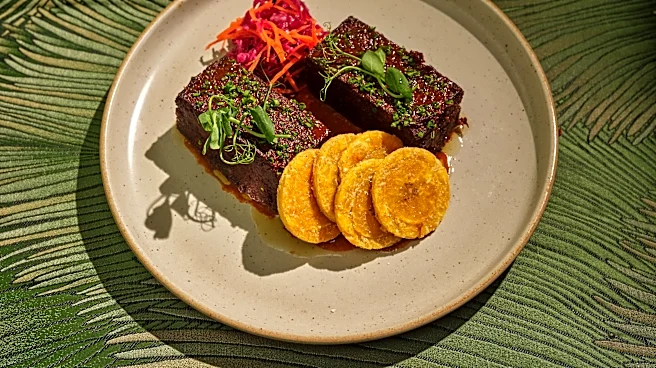






When Kerline Ordeus launched her cooking class series Haitian Knockout Kitchen in October 2025, she didn’t know it would become one of the most sought-after seats in Los Angeles. The Haitian-born Ordeus moved to Los Angeles from the Midwest in 2020 and found herself yearning for flavors from home, only to find a sparse selection of Haitian restaurants in Southern California. Just under eight months later, 150 people joined a waitlist for one of 10 slots at Ordeus’s June 14 class, eager to learn how to make green seasoning, peel and fry plantains, and properly marinate meat. Haitian Knockout Kitchen has become part of the contemporary tide of Caribbean restaurants and dining experiences emerging throughout Los Angeles.
“It shows there are people
out there who want to be a part of this, experience something different, and are in search of community,” says Ordeus. “There is a huge need for Caribbeaners in general to have a place like this.”
Unlike New York City or Miami, cities known for the vibrancy of their Caribbean diasporic communities, Los Angeles has only had a small concentration of Caribbean restaurants within its sprawl. More than 1.3 million Puerto Ricans, Cubans, Jamaicans, and more Caribbean diasporic communities reside in New York; while 20 percent of Miami’s population was born in the Caribbean. In comparison, Los Angeles’s Caribbean community lingers just below 30,000, which may explain the scarcity of Caribbean diasporic restaurants compared to communities that have a historic — and larger — presence here: Korean, Armenian, and Mexican, for example.
Los Angeles’s longstanding Jamaican, Belizean, and Cuban restaurants include Sherman Oaks’ Coley’s Original, a Jamaican restaurant open since 1982 (first in Leimert Park and currently in its longtime San Fernando Valley home); the nearly 20-year-old Tracey’s Belizean in Exposition Park; and the popular Porto’s, which has held down its Cuban bakery dominance over Los Angeles since the 1970s. But even with a few icons anchoring the scene, the prevalence of Afro- and Latin-Caribbean restaurants has remained small throughout the Southland and mostly localized to areas such as South Los Angeles and Inglewood.

That is, until the last few years. Fairfax’s Lucia became Los Angeles’s first fine dining Caribbean restaurant in 2025, initially with a Jamaican-leaning menu from chef Adrian Forte (who departed months after opening) and now with a more Latin-Caribbean-focused lens from chef Cleophus “Ophus” Hethington. Chef Alejandro Eusebio debuted Amiguita’s Afro-Caribbean menu in March 2026, while ABL took center stage on April 22 with a compelling Jamaican-Chinese menu in Hollywood: Angelenos can find oxtail lo mein, jerk fried oysters, and orange-infused chen pi ji–style wings here, among other dishes. Popular Jamaican soul food restaurant Tev’s & Family Kitchen opened a second location in Gardena in March after the smash success of its original South Los Angeles shop. In early 2026, Trinidadian Demrani Roti + Doubles opened at the intersection of Venice Boulevard and Western Avenue.
If tracing the inception of this wave, many would likely point to pandemic pop-up-turned-permanent restaurant Bridgetown Roti, which takes its influences from Trinidadian, Jamaican, and Bajan food in dishes such as roti wraps, oxtail patties, and channa doubles.

A note of disclosure: Bridgetown co-owner and chef is Rashida Holmes, my cousin. While I have no stake in her business and have never written about her for Eater (until today), it seems impossible to deny Bridgetown’s impact since opening her East Hollywood restaurant in 2024. Though I bowed out of judging that year, the Eater Los Angeles team awarded her pop-up Restaurant of the Year in 2021.
Many food writers and critics have been tracking New York chef Kwame Onwuachi’s career since he grabbed national attention on Top Chef in 2015. He’s another force changing palates west of the Mississippi. In late April, Onwuachi furthered the conversation around Caribbean diasporic restaurants with Maroon, a first-of-its-kind restaurant in the U.S.: his Afro-Caribbean steakhouse in the Sahara Las Vegas resort.
Onwuachi takes an Afro-Caribbean approach to the classic steakhouse, reimagining it through flavors and foodways from Jamaica and the broader Caribbean diaspora. The restaurant is named after Jamaican Maroons who escaped slavery and set up their own communities in the island’s mountains in the 17th and 18th centuries. Maroon’s menu feels irreverent and ambitious with curry goat agnolotti, jerk chicken, oxtail Wellington for two, and creamed coconut collard greens; dishes such as a rack of lamb and pork tomahawk get prepared over a custom-built jerk pit that acts as a centerpiece in the dining room.
I’m enjoying this ride of Caribbean flavors in the Southland and Southwest. Let’s hope it continues.
More for the table
- Read Eater Los Angeles’s Caribbean restaurants map for a vetted list of Caribbean diasporic dining throughout the city.
- There’s so much to take in with Maroon. In case you missed it, Rebecca Roland’s Eater Las Vegas opening story from May.
- Caribbean and African foodways deeply influenced Southern cuisine in the U.S., so check out these soul food and Southern destinations throughout the Southland. In 2022, Eater freelancer Anneliese Wilson penned an excellent story about how Creole restaurants came to Los Angeles.