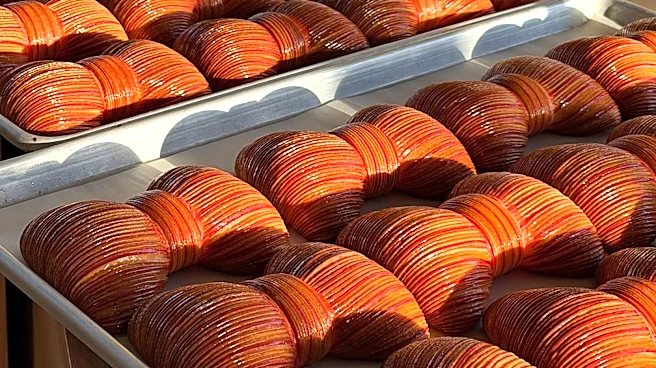





For Parachute Bakery’s first Valentine’s Day in 2026, pastry chef and co-owner Nasir Armar and his team were looking for something less traditional than the heart-shaped fare that’s typical for the holiday. What they landed on was a bow-shaped croissant,
ribbons of striking red color woven into the flaky, crunchy layers, puffy and striped, swollen with raspberry confit-laden cream cheese and lychee gel studded with bits of fresh lychee. “The bow is the final detail that transforms something into a present,” Armar says. “So it was our way of making the pastry itself feel like you were giving something special to someone you care about.”
As a special holiday offering that’s not typically part of the team’s repertoire, the Parachute team spent a week developing and adjusting the measurements, going through multiple prototypes to get to their ideal version. “It just felt very timeless and elegant,” Armar says of the shape. “It was also a way of challenging ourselves to come up with something that represented Valentine’s without it being a heart.” The ideal version necessitated an open honeycomb structure that allowed it to be filled, giving the team another chance to pivot from the usual tropes of the holiday. “We wanted flavors that felt romantic, but also balanced,” Armar says, rejecting typical pairings such as white chocolate and raspberry that he feels can be overwhelming. They ultimately landed on a two-filling croissant, the raspberry cream cheese and lychee gel, which bring brightness and acidity to the table, while still feeling rich and decadent, Armar says. “You would take the first bite, and you’d get the croissant dough. Second bite, croissant dough and the raspberry cream cheese. Third bite and there’s this lychee filling that oozes out and you’re like, ‘Wow,’” Armar says.

Bow croissants, or bow tie croissants, are having a moment. Following the croissant trends of spirals and cubes in 2023, the cheerful shape of the bow has tied itself to different bakeries and restaurants across the Bay Area this year. Seasonal offerings like Parachute’s version have cropped up in places like Juniper, which also dropped a salted egg yolk cream and sesame cream-filled version for Valentine’s Day following its Lunar New Year debut, or Bonjour Bakehouse in San Mateo, which offered a chocolate and pecan praline version for Father’s Day in June. It even turned up as part of a recent summer dessert course at three-Michelin-starred SingleThread. Meanwhile, places like Le Marais and La Fromagerie offered their own versions in 2025. It’s a technically difficult shape that goes beyond the daily croissant production of most bakeries — “I would 100 percent say it was the most difficult pastry we shaped,” Armar says — but the croissant has received much love and awe from customers.
Bow croissants combine a number of techniques in Viennoiserie, including two more modern developments: cross lamination and bicolor croissants. Lauren Haas is a pastry chef, educator, and consultant, and she pointed to the Coupe du Monde de la Boulangerie baking competition as one of the places where modern lamination techniques and innovation spring from. Pastry chef Peter Yuen of Chicago is considered one of the first innovators of the cross lamination technique, showcasing the style at the Coupe du Monde de la Boulangerie 2008, per Pastry Arts. In 2010, French baker David Bedu pioneered biocolor croissants, creating the two-tone pastries with stripes of red, green, blue, and more that began seeping into bakeries at that time. “I think those competitions are really where innovation can really start, and then the industry sees that and they start to build upon that innovation,” Haas says. “It takes a long time to get it into a typical production because it does require additional skills and more precise handling of the dough.”
Haas further named the 2020 book Signature Viennoiseries by French pastry chef Johan Martin as another reason why modern croissant shapes took off in local bakeries. The book, which was published in French and English, “really inspired people in terms of what they could do with Viennoiserie in different shapes,” Haas says. “I think that was the next evolution because we had seen things in competitions, but he made a book and he did recipes and explained how to do it — and since then it’s just really taken off.”
But tracing the origins of the bow croissant has gotten tricky in the age of social media. Armar credits Ry Stephen with the shape, formerly of Mister Holmes Bakehouse in San Francisco, and later Supermoon Bakehouse in New York City. Meanwhile, Monique Feybesse of the popular Oakland bakery Tarts de Feybesse says she first spied the striking bow shape in Paris two years ago, before it hit it big in Korea and Hong Kong. Monique Feybesse and husband Paul Feybesse have baked the bow-shaped croissant at their space since opening in 2024, incorporating fillings throughout the year and that signature two-tone look. Their mainstay option is a raspberry cream-filled version with stripes of red throughout, but other flavors that have floated through the pastry case include blueberry, strawberry and pistachio, and calamansi, a citrus that originates in the Philippines. “It’s aesthetically pleasing, but when you can fill it with something absolutely delicious, it makes it much more fun,” Monique Feybesse says. “It makes the experience much more interesting, rather than just getting a raspberry-filled croissant.”
Tart de Feybesse’s signature bow has reached a five-inch diameter, a large enough vessel to hold those piped cream fillings. Monique Feybesse says the couple loves diving into various baking techniques, working to add things to their repertoire that are a bit different than the standard bakery offerings. The raspberry option is a favorite, where the tart berries cut through and combine with the flavors of the croissant dough. “First and foremost, it’s super distinct — it’s something that is a joyful product,” Monique Feybesse says. “When you see a bow tie, it’s for celebration, it’s to celebrate something. So automatically it’s unique in itself.
She adds that, “for the team, I think it’s a learning point for them. It’s something that inspires us to do different shapes and learn from each other. So that’s one of the reasons why we do it: We hate being bored.”