






Washington, D.C. has spoken yesterday, and an overwhelming majority of voters (73 percent) checked yes on their Election Day ballots to prevent foie gras from being served at restaurants as soon as next year.
First, here’s a breakdown on what the newly
passed Initiative 86 says:
- Prohibit farms from force-feeding birds to enlarge their livers beyond normal size.
- Ban businesses from selling and distributing fattened bird liver products, including foie gras.
- Prohibit importing those products into D.C. for sale, distribution or other commercial purposes.
- Establish civil fines of $1,000 to $5,000 per violation. Repeated violations could lead to suspension or revocation of a business license.
The measure will be active on July 1, 2027, which means there are technically eight months left to order the delicacy for dinner in D.C.
But not so fast; there are plenty of potential hold-ups that could stop the ban from happening along the way. For one, the D.C. Council has to come up with over $300,000 to put the ban into motion, per estimates from D.C.’s chief financial officer. Chef Bart Hutchins, who runs Capitol Hill’s foie gras-fueled restaurant (and popular Republican stomping ground) Butterworth’s, tells Eater today that he’s “unmoved” by the ban’s passage.
“The vote is almost entirely symbolic,” he says. “Without a funding mechanism its enforcement will be left up to a city council that doesn’t have the budget.”
Another potential delay is likely litigation by the big foie gras producers that D.C. restaurants buy from. That’s long been the case in New York City, where voters approved a similar measure in 2019 that was originally scheduled to go into effect in 2022. Four years later, however, foie gras can still be ordered at NYC restaurants.
That’s because the well-funded duck farms of upstate NY, La Belle Farms and Hudson Valley Foie Gras, responded with a string of lawsuitschallenging state agricultural laws, thus, holding the ban hostage in the courts system ever since.
“Logistically I’ll be supporting Hudson Valley foie however I can with their legal efforts,” Hutchins says.
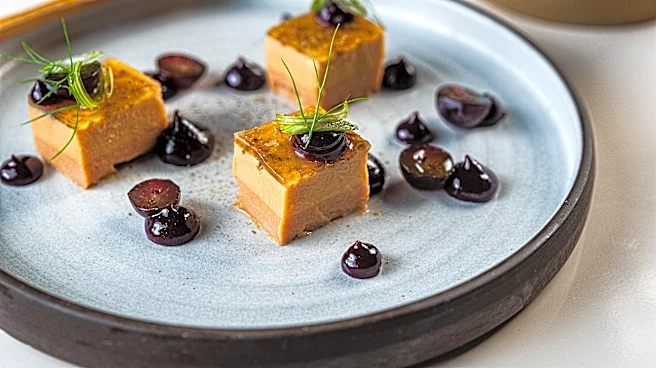
Earlier this week, before the measure passed, D.C.’s critically acclaimed chef Ryan Ratino declined to comment on the potential ban and its impacts on his Michelin-starred French restaurant Bresca, where foie gras (and duck in general) has played a starring role since opening nearly a decade ago at the top of Logan Circle. Foie gras terrines on brioche for two are a luxe add-on to his $145-per-person seasonal tasting menus. And his playful riff on peanut butter and jelly — the foie gras “nutter butter” starter — is a longtime best seller.
Even local chefs that serve foie gras outside of D.C. (and won’t be affected by the ban) are also remaining mum on the matter; John Krinn, who runs northern Virginia tasting room Elyse, declined to comment to Eater today. Neither are high-profile restaurant groups like the one behind thenew Altair in Penn Quarter’s Arlo hotel, which serves foie gras in various ways in both D.C. and its other location in Midtown. (“No comment at this time,” a Renwick Hospitality rep tells Eater on Wednesday.)
Other big-name chefs have no problem with standing up for the delicacy, however. Celebrity chef José Andrés openlysided with serving foie gras in recent weeks, leading activist group Pro-Animal DC to bite back. “Initiative 86 is about ending the sale of fattened enlarged bird liver products …Chef Andrés comparing Initiative 86 to a ban on beef, pork, chicken, or vegetables just doesn’t hold up,” said spokesperson Dani Withaar.
Andrés’s whimsical cotton candy foie gras cones are so popular, they’re one of the few dishes held over from the avant-garde Bazaar before the Waldorf-Astoria restaurant transitioned into Bazaar Meats this year. He doesn’t address the newly approved ban on his active social media accounts today, however.
Another outspoken chef on the controversial topic is TV personality Andrew Zimmern. In June, when Portland’s city council narrowly approved its own ban in a 7-5 vote, Zimmern penned a scathing response on his Spilled Milk Substack, saying there are more important policy issues to address. “Portland picked a fight with foie gras while bigger food battles rage on,” the Bizarre Foods host wrote.
Portland tasting room Le Pigeon, a 2026 James Beard Award semifinalist for best restaurant in the U.S., is among those impacted by the measure expected to go into effect next month in the Oregon city. Back in New York, after years of legal hold-ups, the delicacy could finally be 86’ed at local restaurants. In March 2026, the New York State Appellate Division upheld the city’s ban, and subsequent appeals were later denied, clearing the way for enforcement.
California is, for now, the only state where it’s illegal to sell foie gras; its ban went into effect in 2012, only to briefly be overturned and legal again in 2015, and then reinstated in 2017. D.C.’s grassroots effort to get enough signatures (23,000) and land on this year’s ballot was endorsed by D.C. restaurants like Busboys & Poets, Ben’s Chili Bowl, and Via Roma.
In June, Hutchins penned a Washington Post op-ed on why he’s proud to serve foie gras, pointing to pioneering French chef Jean-Louis Palladin, who helped put foie on the American map during his tenure at the Watergate Hotel.
This newly passed D.C. measure carries fiscal provisions for delay if necessary until their costs are included in an approved budget and financial plan. It also provides for congressional review before becoming law.
“If the council wants to explain to its citizens that foie police is worth skimming the budget for school, its roads or whatever. So be it. But I think it’s extremely unlikely,” Hutchins says.