



Nemanja “Nem” Milunović has an impressive restaurant resume with kitchen gigs at Prime & Provisions, Aba, California’s Manresa, and most recently Adalina Prime, where he worked as executive chef. Yet he always dreamed of finding a permanent place to express
his Balkan heritage, culture, and the cuisine he grew up on. That dream becomes a reality in early January 2027 with the opening of the West Loop’s Amara.
“I spent years working in exceptional kitchens, learning from incredible chefs, and exploring cuisines from around the world, and each of those experiences have shaped me differently,” says Milunović, who was born and raised in Belgrade, Serbia. “But Amara is different because it’s very personal. It’s a reflection of where I come from and everything I’ve learned throughout my career.”
Located in the former Gino & Marty’s space on Randolph Street, Amara will explore dishes from Serbia, Montenegro, Albania, Croatia, Bosnia, Greece, Turkey, and Macedonia, often incorporating lesser-known ingredients and flavors to diners here. Chicagoan Vincent Martin, who’s behind Fulton Market steakhouse Carbon, is Amara’s managing partner. “The goal here is to create an exploration of this cuisine at a deeper level than is widely available,” says Martin, adding that affordability is an important component too.
Some folks have already gotten a taste of Milunović’s Balkan cuisine. During COVID, he created Kiosk Balkan Street Food, a popular ghost kitchen in Avondale. Milunović also appeared at Monday Night Foodball, the weekly chef pop-up series from the Reader’s Mike Sula’s at Thattu. In his most recent Foodball appearance in early October, Milunović offered hints of what he will be doing at Amara with dishes like black truffle knedle, a potato dumpling nestled in Parmesan brodo, and soğan dolmasi, lamb- and beef-stuffed Cipollini onions.
When it opens, Amara will embrace a mezze-style approach to its menu with sharing encouraged. “What I hope with Amara is to contribute a new perspective on Balkan cuisine,” says Milunović. “There is so much culinary history and tradition in that part of the world, and I don’t think it’s been explored nearly enough in contemporary American dining.”

For his version of pašticada, a dish from Dalmatia in Croatia, Milunović subs in braised short rib for beef and pairs it with pljukanci, a hand-rolled pasta, along with fermented vegeta, a dry spice mix. For the traditional prune sauce, Milunović adds tamarind to cut through the dish’s richness and a bit of Parmesan cheese for umami. “That dish is going to bring together centuries of Adriatic culinary tradition with a bit of modern techniques while preserving the comforting soulful flavors that make Balkan cuisine so special,” he says.
A brightly hued saffron sauce-infused risotto served beneath grilled octopus, topped with fried caper leaves. Whole branzino will be prepared buzzara-style, a Croatian technique that involves cooking the fish in a mixture of olive oil, wine, garlic, and fresh herbs. It’s garnished with a citrus butter sauce and breadcrumbs.
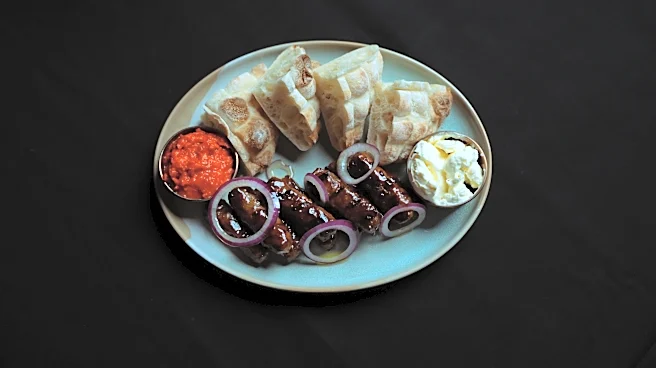
Milunović’s cevapi is a mix of beef and lamb, topped with housemade ajvar, the roasted red pepper spread that’s a signature of Balkan cuisine. His time spent at Chicago’s French Pastry School will come in handy in another one of the many made-from-scratch items here: somun, the soft flatbread the sausage is served on.
Burek, a savory filled pastry that has different interpretations depending on the country it comes from, “is the hardest pastry to make in the world,” according to Milunović, because of the multiple processes needed to create the uber-thin dough, including throwing it in the air. Until staff is trained, Amara’s burek will be offered in limited quantities. The chef found inspiration in Chicago-style pizza for Amara’s iteration, incorporating tomato sauce, pepperoni, and mozzarella. It will be paired with a house yogurt.
The menu will also feature traditional cakes and tortes from Serbia. Future offerings include tulumba, a classic Turkish doughnut-like pastry, as well as other sweets with roots to the Ottoman Empire. In sticking closer to home, his riff on bananas Foster will incorporate palačinke, Balkan-style crepes, with the possibility of a tableside flame presentation with a bit of rakija, a fruit brandy popular in Eastern Europe.
Milanović’s brother, Marko Milonović, is assembling the beverage menu. Nem cites šljuliča, the popular plum rakija, as well as pear, apple, and quince, with a focus on small producers. Amaro, vermouth, and grappa, along with other bitter spirits, will also feature in a menu that includes signature and classic cocktails, some of which will incorporate spices from the kitchen. Coastal wines from the Mediterranean will dominate the list. “We’ve dug up vendors from the corners of the world to be able to provide authentic offerings,” says Martin. “We even have wines from chef Nem and Marco’s hometown.”
Inside the two-story space, which has a kitchen on each floor, there’ll be seating for about 100 guests. Rather than completely gut the former restaurant, Milunović and Martin worked with what was already there to create a cozy, warm Mediterranean feel in the main dining room, bar, lounge, and private dining space. “It’s a minimal change phase and that way it keeps our attention focused on the food and the service,” says Martin. Tones of deep forest greens, warm walnut, aged brass, velvet, leather, and amber-toned lighting provide a juxtaposition to the building’s industrial exterior.
“For me, Amara is more than just opening another restaurant; it’s about creating something meaningful, building an incredible team, and hopefully becoming part of Chicago dining culture for years to come,” says Milunović. “I want people when they hear my name to think, he’s a master of Balkan cuisine. I’ve been waiting for this my whole life.”