




The most defining food moments of my childhood aren’t really from a restaurant, but a food court. And not an ordinary mall food court or a new wave food hall, but a collection of rag-tag food stalls in a temple parking lot in North Hollywood.
Wat Thai
was the first Buddhist Thai temple to open in America back in 1971 when the waves of Thai immigrants in the 1970s banded together to create a community gathering place. The temple remains a Buddhist enclave with daily prayer and Thai festivals, but it has also evolved into a Thai school — which I attended every weekend growing up in the 1990s and early 2000s — as well as a large, beloved community food destination. In Thailand, it’s common to have night markets and mini food festivals at temples across the country, so it only made sense for Wat Thai to follow suit.
In my childhood, the food stalls at Wat Thai were not as defined as they are now. There was the auntie who made drinks (and remains at Wat Thai to this day), and a raggedy wooden hut where another auntie sold candy (the hut is no longer around). There was the stall to eat fermented crab papaya salad and a table set up for Thai desserts where I picked up my weekly dose of tao suan, or mung bean pudding. The food court felt a bit dimensionless; many of the food vendors were just parents of fellow Thai students, setting up shops of fried bananas or vending packaged curries.
The laissez-faire vibe of the Wat Thai of my youth has changed now. Vendors at Wat Thai have banners that display their names and Instagrams. They pop up at other markets, like Damnoen Saduak in Chinatown and Smorgasburg Los Angeles. Some vendors use Wat Thai as an incubator to open up their own brick-and-mortars — like Moom Maam ice cream and Saoha Khao Soi. What hasn’t changed is the requirement to buy tokens (bring cash!); the food, warming and spicy and unapologetically Thai; and the sense of community I feel grounded by every time I step foot on temple grounds.
What to order
It’s somewhat impossible to tell someone how to order at Wat Thai because I really view the temple parking lot as a choose-your-own-adventure situation in which you stop at stalls that call to you. There are stands with curry steam tables and others with freshly pounded papaya salad. Woks hiss and pots of oil gurgle. The smell of charcoal and grilled pork skewers envelops the entire lot. I do, however, have some favorites.
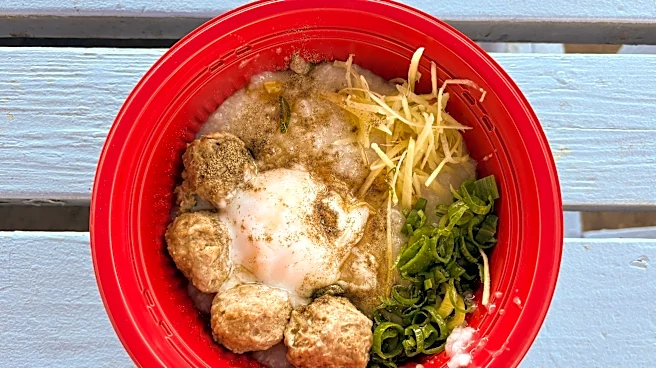
- Sao Ha Khao Soi is known for its namesake dish, khao soi. You can get these fragrant curry noodles in soup or soupless, with toppings like braised beef, crispy pork belly, and plump shrimp. Although I love northern Thai dishes, Sao Ha remains one of the only stands slinging jok, or Thai-style congee. When I come to Wat Thai for breakfast, that is my go-to choice — creamy porridge, bouncy pork meatballs, and an onsen egg topped with matchsticks of spicy ginger and a dusting of white pepper.
- In the southwestern corner of the Wat Thai parking lot sits Judy Crispy Fried Thai Desserts. The fried banana continues to be my favorite option here; stout nam wah bananas get flattened and dipped in a nutty sesame batter and come out of the fryer glistening, crispy, piping hot. Visitors can also find fried taro and spheres of fried sweet potato, which are bouncy like mochi.
- Next door to Judy’s is 170 Sweet Hundred Thai Desserts, seemingly the only stand selling khanom krok, or coconut pudding pancakes. I’m extremely nostalgic for this dessert, which gets made in a cast-iron pan with moon-shaped divots similar to what you would use for takoyaki or æbleskiver. The exterior remains crisp, cradling a custardy coconut center. You can get these pancakes plain or with select sweet or savory toppings like corn, green onions, taro, and pumpkin.
- Thai Sweet Hub sits opposite Judy’s on the northeastern corner closest to the parking lot. Go here to pick up packaged Thai sweets. Mango sticky rice is the big seller, but I’d encourage perusing the colorful assortment of jellies and puddings. Thao suan, or mung bean pudding, is my favorite Thai dessert; the one here is slippery and nutty — an ideal complement to its salty coconut sauce. On hot days, I prefer ruam mit, an icy coconut soup filled with jellies, toddy palm seeds, and sliced jackfruit.

To drink
Wat Thai Cafe is the only major drink stand at the temple. Thai tea endures as a classic for a reason; the version here arrives on the sweeter side and very creamy. For something a bit more out of the box — but extremely Thai — try Hale’s Blue Boy syrup with soda. You can choose green or red syrup (green is a cream soda flavor, while red is sala or snakefruit) that gets topped with club soda. There’s also a version of this drink called nom yen, or cold milk, which trades the club soda with milk. The real star here remains the syrup: red version is my favorite, syrupy sweet and almost rose-like.
Insider tip
The temple food court is cash only — and before you make any purchases, you’ll have to exchange your cash for tokens. The tokens come in $1, $2, and $3 increments in the shades blue, pink, and yellow. The temple itself remains completely open to the public so after chowing down be sure to spend time wandering the grounds and admiring the architecture. You can enter the pagoda to make merit; just be sure to take your shoes off. And if you’re interested in learning Thai, there are lessons available for adults every weekend and a Sunday school for children.
The takeaway
Although much has changed about the way Wat Thai operates (even the coins, which were red, yellow, and green when I was growing up!), what remains is a devoted community, excellent Thai food, and a welcoming atmosphere that feels as close to Thailand as you can get. Is this the best Thai food in all of Los Angeles? Probably not. But visiting vendors, ordering a spread of skewers and curries and desserts, and sharing a picnic table with friends with a temple backdrop feels like an experience you can’t capture anywhere else.