





Two decades after chef Ali Mesghali opened Rumi’s Kitchen in Atlanta, the influential Persian restaurant will make its West Coast debut at Westfield Century City. Opening on Wednesday, September 23, the restaurant brings a menu of fire-kissed kebabs and
long-simmered stews from the Iran-born Mesghali to the bustling mall.
The Los Angeles opening is a full-circle moment for Mesghali, who moved from Esfahan, Iran, to Los Angeles at 11 years old. In tenth grade, Mesghali dropped out of high school and began cooking at Persian restaurants across the city. Though it felt like a distant dream then, he hoped from a young age to one day open a place of his own. In the early 2000s, Mesghali became unhoused and began to look for a path out of Los Angeles. “I had some challenging times in L.A.,” he says. “That’s why I had to leave.” After a move to Atlanta, Georgia, he found shelter, got sober, and started going to Alcoholics Anonymous meetings. “My first year I was selling encyclopedias door to door because I didn’t want to be around restaurants and alcohol,” Mesghali says.

With one year of sobriety under his belt, he started cooking again, and in 2006 he opened the first Rumi’s Kitchen with his then-fiancée, Maryam Tabassian. The duo went to banks for SBA loans, but after each one turned them down, they borrowed more than $100,000 on a credit card and opened in a small 1,600-square-foot restaurant with an 800-square-foot patio. Six months later, they ran out of money, and Tabassian suggested they pawn her engagement ring to keep the restaurant afloat. At the time, Mesghali was the only one in the kitchen who knew how to cook the entire menu; as he tried to bring cooks up to speed, he would inevitably end up throwing away dishes that weren’t prepared correctly. “When the first Rumi’s Kitchen opened, [Tabassian] used to come to the windows and cry, ‘Ali, please don’t throw away any more food. We have no more money,’” he says.
About seven or eight months in, word got around about Rumi’s Kitchen, and the dining room began to fill up consistently. By 2011, the couple had outgrown the original space and expanded into a 6,000-square-foot building in the same Sandy Springs neighborhood. In 2017, Rumi’s Kitchen opened its second location in Atlanta, and, in 2020, it opened its Washington, D.C., location. Today, the restaurant operates three locations in Georgia, one in D.C., and one in Houston, Texas.
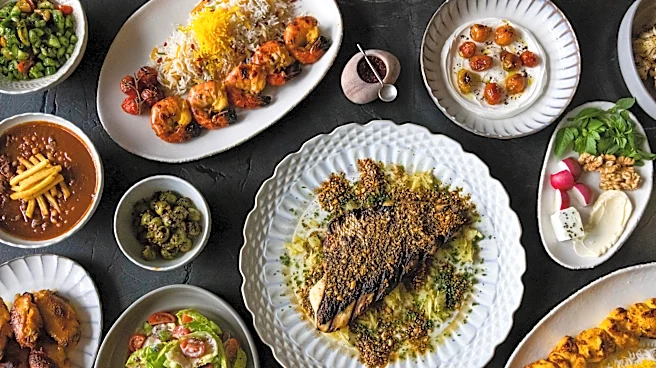
Mesghali says the opening in Los Angeles has been a “dream come true.” In Century City, the menu opens with dishes such as lamb lahmajun (spelled lahmacun on the menu); dolma filled with minced beef, rice, and herbs; kibbeh nayyeh made with lamb and bulgur; and kashk badenjoon with fried eggplant and cream of whey crowned with crispy onions. Kebabs include Chilean sea bass marinated in charred onion and saffron, shish kebab made with a wagyu zabuton, and lamb kebab bedded on lentil and raisin basmati rice. An entire section of the menu focuses on stews, which include an herb-heavy gormeh sabzi, gheymeh, and duck fesenjoon with pomegranate and walnuts; all stews can be paired with sides such as sour cherry-dotted albaloo polo or a gluten-free lavash cracker. Larger dishes, meant to feed three to four, include pomegranate short rib, lamb neck shawarma, a red snapper filet with hazelnut-pepita dukkah, and wagyu tri-tip seasoned with cracked pepper and coriander. Meals can be rounded out with dishes from the market section of the menu, such as fattoush in a lemon buttermilk dressing and roasted crimini and oyster mushrooms with black garlic.
Julian Goglia leads the beverage program, which offers cocktails; wine; doogh, a tangy yogurt-based drink; and beer. Diners can sip on drinks such as the Shah-Toot with mezcal and toot-farangi aperitif or the zero-proof Golden Parasol with naranj and orgeat. Doogh is available sparkling or still, alongside homemade passionfruit or naranj sodas.
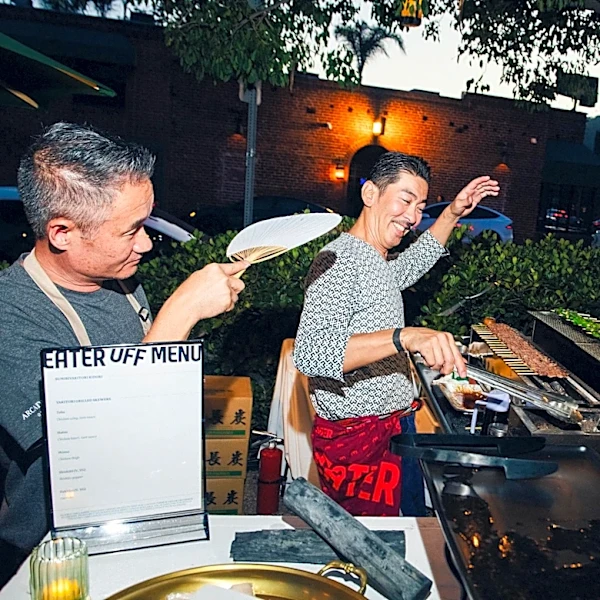
Tabassian, who has since split from Mesghali but remains Rumi’s Kitchen’s director of design, collaborated with Johnson Studio at Cooper Carry for the Los Angeles location, pulling inspiration from a Persian home in California. The 310-seat restaurant features murals from Dean Barger Studios depicting natural landscapes that stretch throughout the space, as well as an open kitchen where the team will cook over coals. Black stone tables ground the dining room, lit by sculptural chandeliers overhead that resemble raw freshwater pearls.
For Mesghali, this opening feels especially emotional as a chance to share his cooking with a community he grew up in. “I always wanted to come back to L.A. and open a restaurant to this magnitude,” he says. “ I’ve reached my goals, everything in life. If I die tomorrow, I’d be a very happy man.”