




This guest essay originally appeared in the Kangtown newsletter, where you’ll find the latest West Coast restaurant reporting, analysis, and industry intel from Los Angeles–based correspondent, Matthew Kang.
It’s hard to think of a phrase in restaurant marketing currently deployed more aggressively than “neighborhood restaurant.” Take three of the most buzzed-about restaurants that have opened in Los Angeles over the past year, all branded as such.
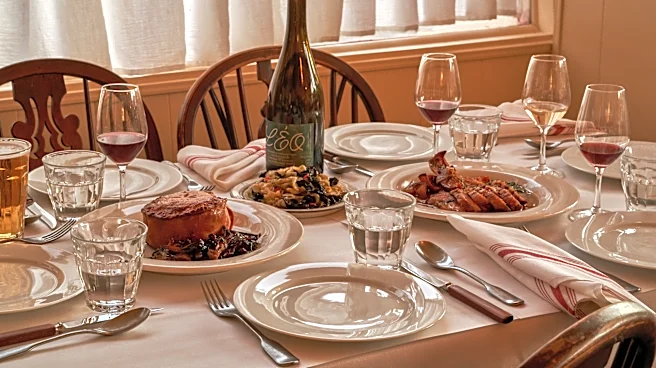
Wilde’s, a seasonal modern-British spot in Los Feliz, aspired to be “a walk-in neighborhood restaurant,” according to its owners. It has an intimate interior and upscale comfort food — but it’s spent much of the past six months sporting impossible-to-book reservations and two-hour wait times, and the menu,
while well-executed, is tiny. It has its charms, but it’s difficult to imagine visiting over and over for a $26 zucchini appetizer and a $42 entree of pork with sage and charred onion.
Sign up for the Kangtown newsletter
This post originally appeared in my Kangtown newsletter, where I cover all things dining in the West. Sign up here to get my latest stories.
Hermon’s opened with a similar ethos: “Hermon’s can be your new favorite neighborhood restaurant, regardless of where you actually reside,” declared the Los Angeles Times, an arguably oxymoronic claim. It rapidly became one of the city’s premier see-and-be-seen dining rooms. I had a great martini and steak frites there recently, but, like Wilde’s, Hermon’s has become a victim of its own success. I would like to go more often, but it’s been booked solid since the holidays. It’s also probably driving its immediate neighbors bonkers; it punctuates a formerly sleepy residential block with a nightly line out the door, a valet lot, and crowds spilling onto the sidewalk.
Then there’s Bar Di Bello, which recently opened in Silver Lake in a gleaming new strip mall that also houses a Malin + Goetz store and a Noma Projects outpost. “We wanted to create a neighborhood restaurant that also feels like a destination,” co-owner Alex Wilmot told Resy, which in turn described the restaurant as “one of the swankiest restaurants Silver Lake has ever seen.” Reservations are booked for weeks, unless you’re interested in dinner at 10 p.m., which few in Los Angeles seem to be. The interior is sleek and manicured; the menu prices are eyebrow-raising.
So what exactly constitutes a “neighborhood restaurant” in Los Angeles in 2026? Can a restaurant requiring weeks of Resy notifications to score a table, a $20 valet fee, and a $250 dinner tab for two really qualify
Traditionally, a neighborhood restaurant is defined by the four Cs: consistent, convenient, comfortable, and casual (and by “casual,” I mean its attitude; it can still be “nice,” too). It’s somewhere you can visit multiple times a week without logistical or financial exhaustion. It’s the sort of place where you can slide into a bar seat alone, gather a group at the last minute, linger over a second drink with a date, or stop by in track pants after a terrible day at work. You recognize the staff; they recognize you. Reservations are largely unnecessary. It provides a service to its community, embodying a welcoming hub where you are free to dine as yourself, in all your many forms.
Los Angeles, by nature of its geography and culture, struggles with all of the above. What constitutes a “local” is blurry. Does one need to live within walking distance? How about within a 15-minute drive? Is emotionally identifying as a regular sufficient? Unlike New York or San Francisco, walking cities where neighborhood restaurants are easy to identify, Los Angeles’s neighborhoods are fragmented, with inconsistent density and foot traffic. Group dinner plans often involve a 35-minute drive for one or several attendees, who have to pretend not to be irritated by circling for parking. You may be able to stroll and spontaneously drop into a restaurant in Echo Park, Highland Park, or Santa Monica, but large swaths of Los Angeles can feel actively hostile to pedestrian wandering.
But that doesn’t make neighborhood restaurants impossible here; they just tend to take different forms. In my enclave of Hollywood, I would vouch for Thai strip-mall spot Ruen Pair, historic Clark Street Diner, quaint Beachwood Cafe, and the mediocre but friendly and deeply reliable Mexican restaurant in Franklin Village with $7 margarita happy hour specials. Further east, I see neighborhood-restaurant success at places like Capri Club, La Pergoletta, Gloria’s Cuisine, All Time, Lowboy, and Joy, where many diners return over and over without ever needing reservation notifications. I recently visited Henrietta in Echo Park and felt its strong neighborhood-restaurant energy; walk-ins are welcome, service is relaxed, the menu is homey and satisfying, and you can stop by during the day for salads and sandwiches.
The true neighborhood restaurant feels easy rather than aspirational, operating in opposition to sceney-ness, eliteness, and aggressive PR cultivation. If a restaurant is impossible to get into, optimized for social visibility, and seats you next to influencers documenting Aperol spritzes and beef tartare with a blinding ring light for a come-with-me TikTok, it naturally becomes less appealing as a repeat destination. There’s nothing wrong with leaning into an Instagram-friendly aesthetic and cultural-discourse-optimized menu, but both are antithetical to the enduring neighborhood-restaurant mission.
Affordability matters, too, when it comes to allowing for frequent visits. This is why many of Los Angeles’s truest neighborhood restaurants are not the ones most aggressively marketed as such; they are family-owned Armenian grills, fluorescent-lit Thai and Vietnamese spots, informal sushi restaurants, and sports bars with unexpectedly excellent burgers. The average person cannot sustain treating a $150-per-person dinner as an anytime weeknight occurrence, no matter how “casual” the restaurant insists it is. You cannot simply declare yourself a neighborhood restaurant while simultaneously aspiring to velvet-rope-level scarcity economics.
Increasingly, “neighborhood restaurant” has become less a functional descriptor than a branding shorthand for a certain type of effortless urban cool. Like “third space,” “quiet luxury,” or “girl dinner,” it has become memeified and oversaturated to a point of contextual meaninglessness.
Most importantly, a restaurant only becomes a neighborhood restaurant once the neighborhood decides it is one. It’s shaped not by hype, but by accessibility and perceived value to its most loyal customers. Regulars cannot be manufactured overnight, so building a neighborhood restaurant requires the one ingredient no branding strategy can artificially accelerate: time.