




Walking into West Town’s Guillotine Bakery it’s hard to know where to look first. There’s the sparkly copper U-shaped counter near the front door. Above it hangs six industrial lights emitting a soft yellow glow. An old link chain is delicately draped on one of the earth-toned, color-washed walls. But come Wednesday, June 17, when the bakery opens, there’ll be something even more eye-catching: a large room in the corner with windows on two sides, with a team of chefs inside making the baked goods you’ll soon be eating.
“We wanted to give a center stage to the bakers,” says co-owner Alizé Bikard. “Oftentimes, especially in Paris, bakers work nights, they work in the basements, and they never see the light of day or the customers.”
Adds business
partner Vincent Didry, “They’re the big stars of the show creating the magic, so they need to be seen.”

The name Guillotine, a clear nod to the French Revolution, was perhaps the first clue that Didry, Bikard, and cofounder Vince Le Bec would be doing something different at their West Town bakery.
“We are trying to blend traditions with something new, edgy, and cool,” says Didry, who previously worked in Paris bakeries such as macaron destination Laudrée and Pierre Marcolini. “The name had to be something that people would remember and sound French.”
Eschewing French stereotypes and cliches was important. “This is a different take on what French culture is and what France looks like,” says Bikard, who met Didry when they both worked at the French Bastards boulangerie in Paris. “There’s not an Eiffel Tower on the wall or a ‘Oui, oui, we’re French’ vibe.’”
“And no fucking Emily in Paris,” adds Didry.
One aspect of French baking that did make the trip across the Atlantic: ingredients. Guillotine is sourcing its butter from a specific region in Normandy known for its grass and, hence, the milk from its cows. Flour will be imported from France, too.
That butter will be used in a number of its baked goods, including croissants, traditional and not. “It’s taking the old and the new, Paris and Chicago, and creating new things,” says Bikard, adding that the U.S. was chosen specifically for the freedom they can have here.
“The creativity is larger here, so we can do whatever we want. If I want to do a hot dog in a croissant, I can do that [in the U.S.], but in France, no,” Didry says. (FYI: There will be a hot dog in a croissant.)
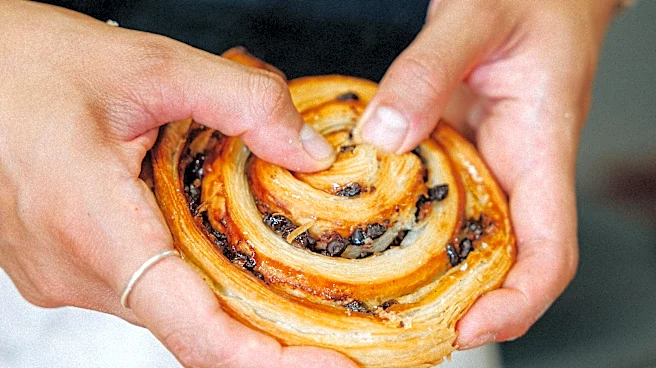
The butter will also be used in the making of kouign amann, the crispy on the outside, soft on the inside pastry that’s earned fans outside France. Le Bec, who is Guillotine’s head baker (Bikard handles front-of-the-house duties, while Didry manages both sides of the business) is from Brittany, the region in France where kouign amann was invented. Pain Suisse, made from croissant dough and layered with vanilla pastry cream and chocolate chips, will also take advantage of that imported butter along with a rotating roster of French pastries like pain au chocolat. “We are bringing very classic things, but also embracing American expectations and habits,” says Didry.

Bread is also on the menu at Guillotine, including baguettes, made with a house sourdough levain, a natural starter. The same goes for its pain de Campagne. A long fermentation process adds more flavor. “We put it in everywhere,” says Didry of the starter. “It has an impact on gluten, making it easier to digest.”
The breads, like all the pastries, are made by hand. The process starts in the glass-enclosed kitchen with the rolling process on a marble countertop — it’s a few degrees cooler than quartz, says Didry, which is better for the dough — followed by lamination and cutting.
Baguettes will be used to make a handful of simple sandwiches like a classic ham and cheese. Demi baguettes are in the works. “Those are less of a commitment,” says Bikard.
Guillotine worked with Chris Chacko of Chicago-based Sparrow Coffee to determine the best blend for the bakery. Unlike at some of the city’s newer coffeehouses, there aren’t any fancy flavored coffee drinks coming out of the espresso machine. The menu will offer “simple, good coffee and a couple seasonal specials when we have the bandwidth to work on that,” Bikard says.
The team worked with Chicago’s Siren Betty Design, who also designed neighboring Brasero, to turn the former art gallery into a bakery. “It needed to feel French, but bold, underground, and kind of revolutionary,” says Didry. “We told them [Siren Betty] we want something elegant but with an industrial vibe.”
Seating ranges from four seats at the U-shaped counter and a banquette to a smattering of small, round metal tables. A 10-seat high counter next to one of the windows gives front-row viewing to the baking process; it seems destined to be in high demand.
Didry and Bikard were still living in Paris when they started thinking about opening a bakery in the U.S. Chicago was on their shortlist of city options. Bikard, who is American and French, had been there, but Didry had not. To determine if it was the right place to open a bakery as well as live, Didry signed up for dog-sitting stints. “I needed to live in the neighborhoods to understand them,” says Didry. Bikard did the same when she was able to get time away from her job in Paris.

“Chicago is a foodie city, and people are very proud of that,” says Bikard. “We’re very obsessed with food, of course, and there are bakeries here, but the city is huge. There’s so much room for new concepts and bringing something different to the table.”
Adds Didry, “Chicago’s very special. I don’t know if we would’ve had this anywhere else.”
Guillotine Bakery, 1711 W. Chicago Avenue; open 7 a.m. to 3 p.m. Sunday, Monday, and Thursday and 7 a.m. to 5 p.m. Friday and Saturday; closed Tuesday and Wednesday.