
In my wilted salad days of food blogging in the pre-recession late aughts, I got the chance to try two-Michelin-starred Mélisse in Santa Monica for the first time, paying $65 for a special four-course tasting menu of tea-smoked ahi tuna and Cornish game
hen jambonette. (That menu is now $399). It was fine dining at a price I could reach on an entry-level salary. At the time, I don’t think we realized how severe the Great Recession would be, but just a few months later my career and personal life were upended because of it. Los Angeles fine dining restaurants were scrambling to get diners through the door: Saam at the Bazaar (the predecessor to Somni, a meal that’s now $1,000 a person) was charging $95 for 22 courses, and even Providence (now with three Michelin stars) had a sub-$100 prix fixe.
Sign up for the Kang Town newsletter
This post originally appeared in my Kang Town newsletter, where I cover all things dining in the West. Sign up here to get my latest stories.
If affordable tasting menus presage a coming recession, maybe the one economists have been warning us about is imminent. In Los Angeles and beyond, I’m seeing tasting menus at prices that recall 2009-2010.
Firstborn went from a la carte to a four-course prix fixe for $68, Bengara includes drink pairings in a six-course set for $98 a person, and Electric Bleu has a four-course tasting for $79 (alongside a full bistro menu). Majordomo, meanwhile, commenced a $175 “Domokase” at the counter on weekdays with eight kinds of handheld ssam, the Sky Room just launched a chef’s tasting of five courses for $135, Da Prato’s modern Italian counter tasting also runs just $135, and Hermosa Beach’s Vin Folk scrapped its wine bar-esque bill of fare for a $175, 10-course degustation.
Baroo co-owner Mina Park, whose celebrated tasting menu costs $140 a person, told me it’s so much easier to control costs when you can plan out exactly how much to order. I keep hearing that restaurants are struggling, and I appreciate the balance some of them are striking between quality cooking and attainability. The three newer, notably more affordable tasting menus I tried offered mostly solid value
Bengara
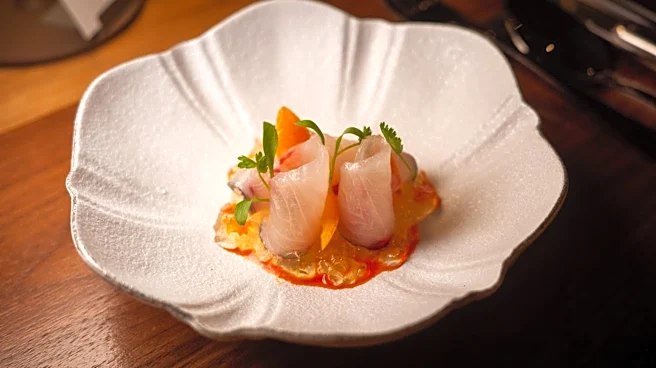
At this three-month-old Arts District izakaya, a $98 six-courser comes with an alcoholic or nonalcoholic beverage pairing, making it one of the best deals in town right now. Chefs Tyler Burges and Phil Mireles put out a tightly wound modern Japanese menu, sourcing fish from Tokyo’s Toyosu market. Curled snapper sashimi comes over cold dashi gelee. Thick pork belly slices nestled in a thin wrapper conjure something like Beijing duck. Agedashi tomato, cooked in its juices and then flash-fried, bursts with the freshness of summer. You will likely fight over the last bites of blackened, miso-topped eggplant and a juicy, blistered half-chicken. The savory section ends with citrus-topped soba skillfully made by hand. Those with larger appetites might still need a slice of pizza (maybe from Lynx, just a short walk away), but Bengara offers an attractive entry price and polished cooking.
Electric Bleu

Aussie chef Craig Hopson’s Electric Bleu brings California-inflected French bistro fare to a residential section of Mar Vista. The high energy and tightly packed tables make it feel like a real neighborhood gem, though the standard menu feels like a fairly pricey date night. The $79 tasting helps the cause. Chicken liver mousse piped into an onion wafer taco leads the way, then two slices of yellowfin tuna crudo come draped over tangy watermelon chunks. A slender slab of miso Parmesan tart has grilled figs on top. A very rare seared duck breast serves as the main course, sided with Champagne grapes and purslane, and there’s a slice of roll cake topped with mango cubes for dessert. It’s all well-sourced and tasty and, if you have a smaller appetite, probably enough. Since I don’t lean that way, I recommend fortifying the meal with the textbook pate en croute and a warm baguette loaf with butter.
Majordomo
On the other side of the portion spectrum, you get Majordomo’s midweek special “Domokase,” which chef James Bailey puts together at the counter. I’m still a huge fan of this sprawling David Chang-founded Chinatown restaurant with its focused menu of mostly Korean-influenced dishes. Most of the Domokase’s 10 courses are variations on ssam, typically meat topped with kimchi and spicy sauce (ssamjang), then wrapped with lettuce or another leafy green.
Like any proper meal, this one includes banchan, like a kimchi made with heirloom tomato, and light-as-air micro rice ball bugak. A stunner of dry-aged tuna, salmon, and yellowtail, marinated ganjang shrimp, and smoked trout roe comes with crisp lettuce and perilla leaves. The build-a-bite process would’ve put a smile on my grandfather’s face. Caviar-topped cold fried chicken wrapped in iceberg lettuce recalls one of Chang’s most beloved dishes at Momofuku Ko. There’s a carby interlude with Majordomo’s bing bread, topped with a knob of tender lamb rib. The somewhat comical “hand salad” is just a highly dressed meatless ssam that leaves your fingers sticky. The meal culminates with grilled steak, braised brisket, and seemingly endless slices of Majordomo’s famed smoked short rib — with all the ssam accoutrements — after which you will be ridiculously, tremendously full. At $175, it’s at the higher end of “affordable” and actually an impressive deal.