





Chef Ravi Kapur’s Liholiho Yacht Club is a hard restaurant to categorize. It’s often described as a Hawaiian restaurant, but it goes much deeper than that, mixing influences from Kapur’s childhood in Hawaii, and his heritage — his Native Hawaiian and Chinese mother, and his father is from India. And it’s all augmented by his time cooking in San Francisco restaurants. It makes for a distinctly rich and original restaurant.
Liholiho’s journey hasn’t been linear. The restaurant, which debuted in 2015, was impacted by the pandemic in 2020, doing takeout for a year before temporarily closing the Nob Hill location. It reopened as a pop-up in the Mission for part of 2021, before that location evolved into sister restaurant,Good Good Culture Club, in 2022.
Eventually, Liholiho returned to its Nob Hill roots in November 2022 after a space refresh, and now that the restaurant is hitting “middle age” — that time period when a restaurant is a few years into its tenure, no longer dealing with new-kid jitters — it’s worth seeing why the restaurant continues to lure diners to its stretch of Sutter Street to this day.
The vibe

The restaurant feels casual in nature, with its dynamic colors and patterns — which include the gorgeous, vintage black-and-white photo of Kapur’s mother and that bright yellow-tiled kitchen — but it is a place that, for some, may inspire a bit more dressing up than the typical San Francisco uniform. I say this because it seemed to read as a celebratory restaurant for many; during my visit, I witnessed at least two sparkler-loaded desserts walked to tables, as well as twosomes that looked very swoony and date-coded. That being said, the staff is welcoming enough not to turn their noses up at what anyone’s wearing, so go with your gut on what feels comfortable for your specific dining occasion here.
What to order
- Of the singular bites my table tried, the standouts were the caviar taro puff ($11 each) and the duck liver mousse ($8 each). The caviar taro puff is not a standout for the caviar (although it doesn’t hurt); rather, it’s the play of flavors seen in combining smoked pineapple, the lacy, fried taro, with the salinity of caviar. That playfulness also extends to the duck liver mousse, which is combined with strawberry-fennel jam and pickled rhubarb, all set against the unusual banana bread base. I’m not saying that combination shouldn’t work, but it works.
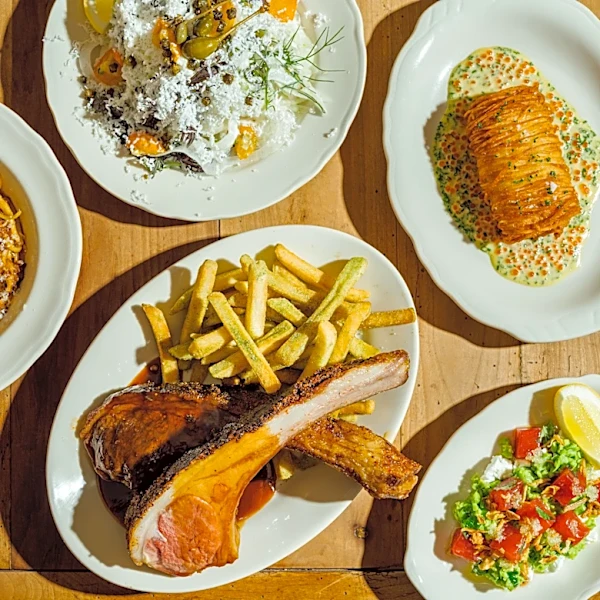
- The gulf shrimp ($27) pairs bouncy shrimp with XO butter and baby tatsoi vegetables. The diced, crispy polenta adds a crunchy texture element to the mix, but it’s the paprika aioli that really pulls everything together for me.
- The scallion rice noodles ($24) are more vegetable-forward than rice noodle-heavy, allowing bright sugar snap peas, bean sprouts, and mushrooms take center stage, dressed in a black bean chile sauce.
- The pork shoulder chop ($46) is the most oft-ordered of the entrees, but I was able to try both the American wagyu zabuton ($59) and local black cod ($41). The zabuton steak doesn’t miss, but the intriguing black cod wows with the subtle tang of tamarind-laced butter, next to heirloom beans that arrive two ways: crisped and tender. The fish was also tender and not overcooked, a plus in my book.
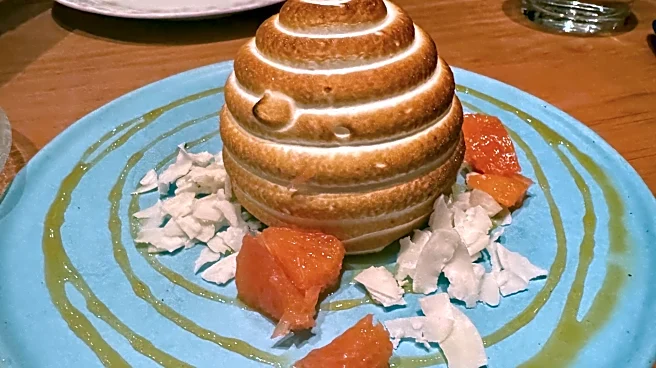
- The signature baked Hawaii ($15) with its torched exterior and delicious coconut-POG sorbet interior is a classic for a reason. If it’s your first visit, this is practically required, but if I were to do things over again, I might instead reach for Mom’s Butter Mochi with coconut custard ($15). If it’s from mom, it can’t be wrong… right?

The drinks
The drinks menu is well-considered, with cocktails made with palm and pineapple gin, agricole rum from Hawaii-based brand Kō Hana Rum, and hojicha-infused Suntori toki whisky. I went for the High Tide, made with that aforementioned palm and pineapple gin from Bayab, mixed with Cocchi Americano and tonic, although for my next round (in a world where I’m not driving), I have my eye on the hojicha highball. There is a selection of beers and seltzers that continue the flavor themes of the food menu, currently sporting a POG sour and pineapple hard seltzer; nonalcoholic options also get some consideration, such as a lemongrass soda with ginger and lime. The wine list is decently stacked — especially judging from the bottles on display across from the restrooms — spanning both domestic and global wine brands.
Insider tip
It’s not listed on the printed menu, but a server let us know that the kitchen does a set menu for about $80 per person (with full table participation). If you’re intent on eating across the entire menu, like I was, this is the way to go. My table received much more food than anticipated — although I did push us to the limit with two extra dish orders to bring more to the Dining Report table — so it’s a worthy splurge.
The takeaway
If you pressed me to say whether there’s a comparable restaurant to Liholiho Yacht Club, I’d be at a loss. It’s a singular point of view and style of cooking unique to Kapur, that he continues to hone at Good Good Culture Club. The food, drink, and vibe intersect in a pleasant way that makes for an enjoyable night out, all buoyed by a helpful and kind team.