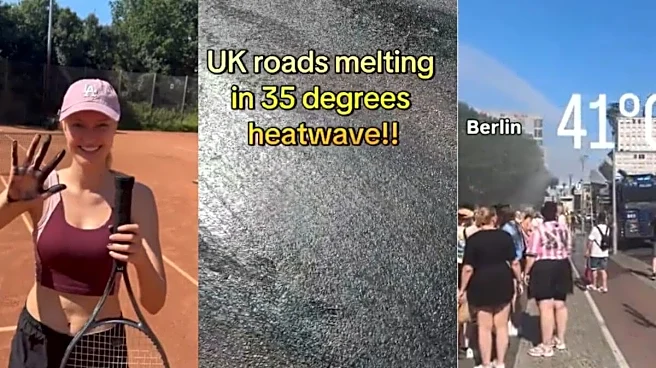
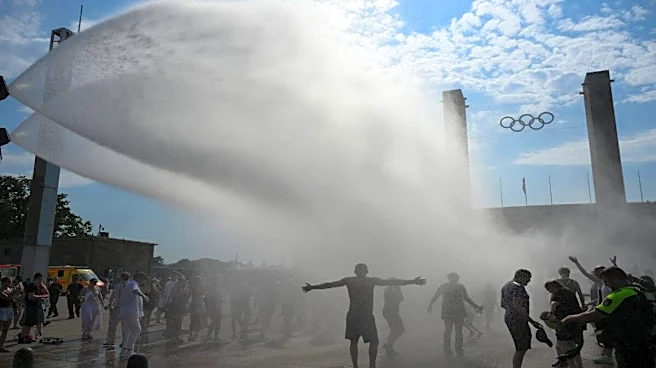
As Europe heatwave continues to go on, Berlin has found an unusual way to help people beat the heat: water cannons. Normally associated with riot control, Berlin police recently repurposed two water cannon trucks to spray fine arcs of water over tourists and residents gathered near landmarks including Brandenburg Gate, Potsdamer Platz and the Reichstag. The move came as temperatures in parts of Germany climbed above 40°C, prompting authorities to issue heat warnings and deploy emergency cooling measures.The scenes quickly went viral. Smiling tourists stretched out their arms to catch the cooling mist, while others welcomed the unexpected relief from the relentless sun. But beyond the dramatic visuals lies an important health question: Can getting
sprayed with water actually protect you from dangerous heat?Read More: Psoriatic Arthritis: The Skin-Joint Connection Your Doctor Probably Never Explained
What Doctors Have To Say
According to doctors and heat researchers, the answer is yes, with some important caveats. "The human body cools itself mainly by sweating," explains Dr. Renee Salas, emergency physician and climate and health expert at Harvard T.H. Chan School of Public Health. Sweat evaporates from the skin, carrying heat away from the body in a process known as evaporative cooling. When temperatures soar above normal body temperature, or when you're producing heat through walking or standing in the sun, this natural cooling system can become overwhelmed. Adding water externally mimics this process.
Whether it's a misting station, a spray bottle, a garden hose or, in Berlin's case, a water cannon set to a gentle spray, water on the skin evaporates and removes heat from the body, helping lower skin temperature and reduce thermal strain. It's not just about feeling cooler Dr. W. Larry Kenney, professor of physiology at Pennsylvania State University and one of the world's leading heat stress researchers, has spent decades studying how the body responds to extreme temperatures.His research has shown that cooling the skin significantly reduces cardiovascular strain during heat exposure. In extreme heat, the heart works harder to pump blood toward the skin so heat can escape. If cooling methods reduce skin temperature, the heart doesn't have to work as intensely. This can be especially important for older adults, whose bodies sweat less efficiently and struggle to regulate temperature.
Doctors also point out that the cooling effect doesn't come simply from getting wet. It's the evaporation afterwards that does most of the work. In dry climates, water evaporates rapidly, producing almost immediate relief. In humid weather, however, evaporation slows down because the air is already saturated with moisture. That's why someone can feel unbearably hot even after getting drenched if humidity levels are high. Germany's heatwave has largely been characterised by hot, relatively dry air, making misting and water sprays particularly effective.
What WHO recommends
Health agencies around the world recommend using water as one of the simplest and fastest ways to prevent heat illness. Advice from the World Health Organization and the US Centers for Disease Control and Prevention includes taking cool showers, wetting the skin with damp towels, using misting fans and applying cool water to exposed skin during heatwaves.The principle remains the same regardless of whether the water comes from a shower, a spray bottle or a specially adapted water cannon. But water alone won't stop heatstroke Doctors caution that while water spraying provides genuine relief, it is not a substitute for proper heat protection. If someone is developing heat exhaustion or heatstroke, simply getting wet will not reverse the condition.Heatstroke is a medical emergency in which core body temperature typically rises above 40°C, and symptoms can include confusion, dizziness, rapid heartbeat, fainting and altered consciousness. In such cases, rapid cooling, emergency medical attention and hydration become critical. Likewise, standing in direct sunlight after being sprayed may provide only temporary relief if the person continues to lose fluids through sweating.
Why Cities Are Embracing "Cooling Infrastructure"
Berlin isn't the only city experimenting with creative cooling strategies. Across Europe, municipalities have installed misting stations, water curtains, splash zones and temporary fountains as climate change drives more frequent and intense heatwaves. Italy, France, Spain and Poland have also expanded public cooling infrastructure during recent heat emergencies. Urban health researchers increasingly view these interventions as part of "heat adaptation"—small environmental changes that reduce heat exposure for thousands of people in public spaces.So, do Berlin's water cannons really work? Doctors say yes.A gentle spray of water can lower skin temperature, enhance evaporative cooling, reduce the strain on the heart and provide immediate comfort during extreme heat. While it won't replace hydration, shade or medical care in severe heat illness, it is a scientifically backed way to help the body cope with soaring temperatures. As summers become hotter around the world, including in India, where many cities regularly cross 45°C, Berlin's unusual use of water cannons may look dramatic. But the science behind it is surprisingly simple: when the body's own cooling system starts to struggle, a little water can go a long way.
Read More: E-Comms Hiding Health Info: Are Quick Delivery Apps Making It Easier To Buy Prescription Medicines...Without Prescription?
/images/ppid_a911dc6a-image-178281608241378907.webp)







/images/ppid_59c68470-image-178299003847829953.webp)

/images/ppid_a911dc6a-image-178289682576780909.webp)


/images/ppid_59c68470-image-178273258406052785.webp)
/images/ppid_a911dc6a-image-178273767303944928.webp)