



Have you ever pulled on a pair of pants only to find the side seam mysteriously migrating toward your shin? Or noticed a new shirt twisting oddly after just one wash? The culprit isn't bad sewing or a faulty pattern—it's fabric grain.
What Is Fabric Grain, Anyway?
Think of fabric grain
as the hidden skeleton of your clothes. Woven fabric is made of threads running in two directions: lengthwise and crosswise. The lengthwise threads (called the warp) run parallel to the finished edge of the fabric, known as the selvage. The crosswise threads (the weft) run from one selvage edge to the other. These threads form a grid, and that grid has rules. The lengthwise grain is the strongest and most stable direction, with the least amount of stretch. This is because the warp threads are held under tight tension during the weaving process. Respecting this structure is the most important step to creating a garment that hangs correctly and holds its shape.
The Three Grains You Need to Know
There are three 'grains' or directions in every piece of woven fabric, and each behaves differently. 1. Lengthwise Grain: This is the strongest, most stable direction, running parallel to the selvage. It has almost no stretch, which is why most patterns instruct you to align the main parts of a garment with it. For trousers, this means the grain should run straight down the leg. 2. Crosswise Grain: Running perpendicular to the selvage, this direction has slightly more give or stretch than the lengthwise grain. This can provide a little extra comfort around the body. 3. Bias Grain: This is any diagonal direction, but the 'true bias' is a 45-degree angle to the lengthwise and crosswise grains. This is where the fabric has the most stretch and drape, as the threads can shift. It's perfect for creating flowing skirts or binding curved edges, but a nightmare if you cut a straight pant leg on it by mistake.
The Straight-Leg Test: Why On-Grain Matters
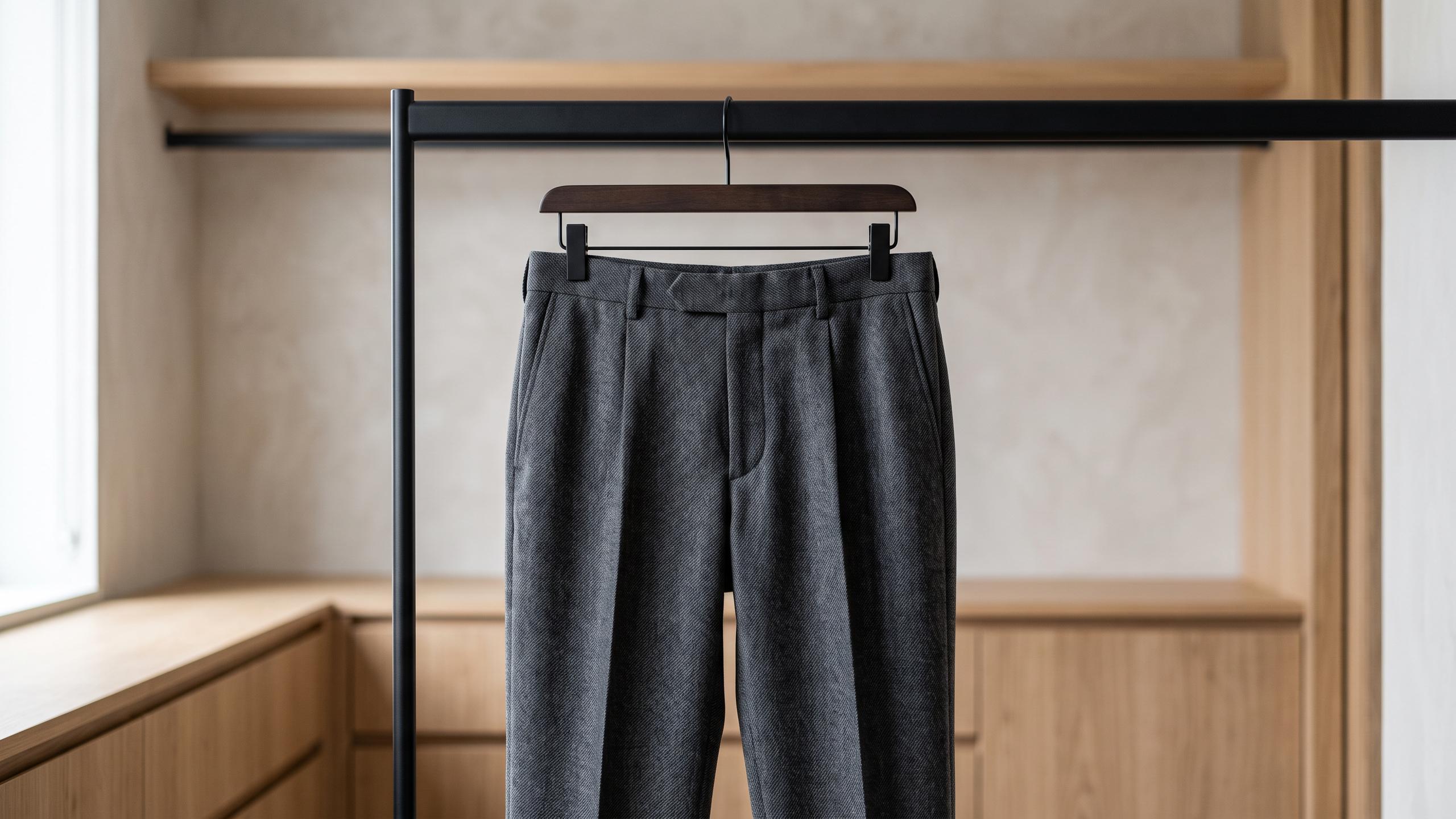
So, how does this relate to your trousers? Gravity. When a pant leg is cut 'on-grain', the strong, stable lengthwise threads run vertically from your hip to the floor. Gravity pulls straight down on these threads, and because they don't stretch, the leg hangs perfectly straight. The seams stay at your sides, and the hem remains level. But if the pattern piece is tilted even slightly—a common shortcut to save fabric—the leg is now 'off-grain'. Part of it is now on the stretchy bias. Gravity pulls on this angled grid, and the fabric begins to stretch and twist in the direction of the grain. This is what causes that annoying seam to spiral around your leg. No amount of pressing can fix this; the flaw is literally built into the cut.
How to Find and Follow the Grain
Before you ever cut, you must ensure your pattern is aligned with the grain. The arrow printed on your pattern piece is your guide; it must be perfectly parallel to the selvage. First, identify the selvage—the finished, non-fraying edge of your fabric. Lay your pattern piece down and use a ruler. Measure the distance from one end of the grainline arrow to the selvage. Then, measure the distance from the other end of the arrow to the selvage. Adjust the pattern piece until both measurements are identical. If your fabric has no selvage, you can do a stretch test. The direction with the least amount of stretch is your lengthwise grain. On some fabrics like cotton, you can also snip the edge and tear; it will naturally tear along the crosswise grain, giving you a perfectly straight line to work from.