
What's Happening?
SpaceX has announced plans to go public, revealing significant financial details in preparation for its initial public offering (IPO). The company reported a $5 billion net loss in 2025, despite generating
$18.7 billion in sales. SpaceX intends to list on the Nasdaq under the symbol SPCX, with the IPO expected to raise $80 billion or more. The company's financial disclosures highlight a first-quarter loss of $4.3 billion on $4.7 billion in revenue, largely due to substantial investments in artificial intelligence, which accounted for $10 billion in capital expenditure. While the launch business and AI operations reported losses, SpaceX's Starlink and related communications systems were profitable, generating $1.2 billion in the first quarter. The company has 10.3 million subscribers and 9,600 satellites in orbit, with plans to expand its services and capabilities.
Why It's Important?
The upcoming IPO of SpaceX is significant as it marks a major milestone for the aerospace industry, potentially reshaping the market landscape. The company's financial performance and strategic investments in AI and satellite communications underscore its ambition to dominate the space economy. The IPO could attract substantial investor interest, given SpaceX's innovative projects and the leadership of CEO Elon Musk, who holds significant control over the company. The public offering could provide SpaceX with the capital needed to further its ambitious projects, including on-orbit AI compute satellites and potential ventures in asteroid mining and interplanetary travel. The IPO's success could influence investor confidence in the broader space sector, impacting funding and development opportunities for other companies.
What's Next?
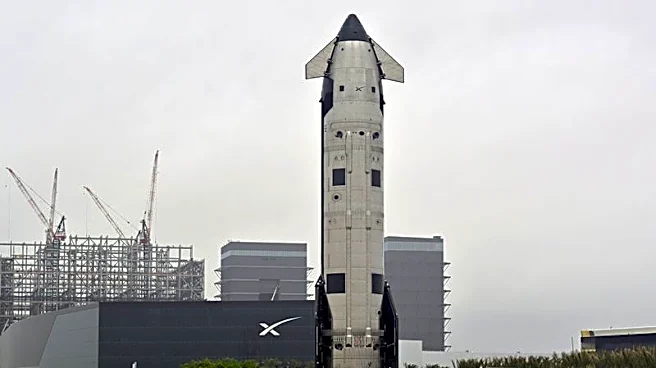
Following the IPO, SpaceX plans to continue its expansion into new markets and technologies. The company aims to start payload delivery using its Starship system and deploy AI compute satellites in the coming years. SpaceX is also exploring future market opportunities such as point-to-point terrestrial travel, in-orbit manufacturing, and energy production on the Moon and Mars. The company's strategic direction and Musk's leadership will be closely watched by investors and industry stakeholders. The IPO's outcome could set a precedent for other private space companies considering public offerings, potentially accelerating innovation and competition in the space industry.