



What's Happening?
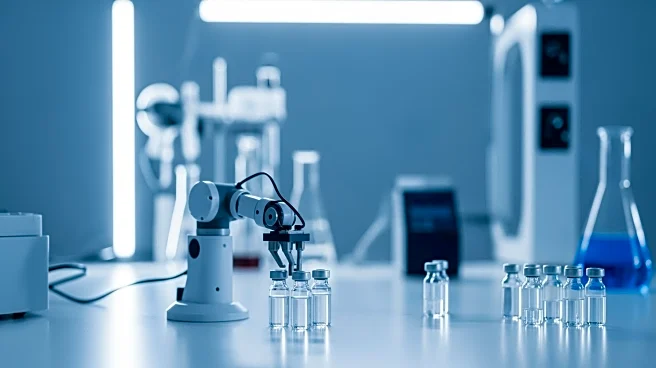
Telescope Innovations Corp., a company specializing in technologies for the pharmaceutical and chemical industries, has installed its second Self-Driving Laboratory (SDL) at Pfizer. This installation is part of a multi-year agreement between the two companies
and was completed in January 2026. The SDL is a cutting-edge platform that integrates collaborative robotics, real-time analytics, and machine-learning to automate chemical research processes. It is designed to significantly reduce development timelines and costs by enabling continuous, autonomous operation. The SDL can accelerate the development of chemical synthesis methods by up to 100 times compared to traditional manual approaches. This installation marks a significant milestone in the transition from collaborative research and development to potential full-scale deployment.
Why It's Important?
The installation of the second SDL at Pfizer represents a major advancement in pharmaceutical research and development. By automating and accelerating the chemical synthesis process, the SDL can potentially lead to faster drug development cycles, reducing time-to-market for new pharmaceuticals. This could result in significant cost savings for pharmaceutical companies and potentially lower drug prices for consumers. Additionally, the SDL's ability to operate continuously without human intervention could lead to more efficient use of resources and increased productivity in the pharmaceutical industry. The collaboration between Telescope Innovations and Pfizer highlights the growing importance of artificial intelligence and automation in scientific research and development.
What's Next?
With the successful installation of the second SDL, Telescope Innovations and Pfizer may explore further deployments and applications of this technology. The SDL's architecture is adaptable to various domains requiring rapid optimization of chemical or materials processes, suggesting potential expansion into other areas of pharmaceutical innovation and advanced manufacturing. As the partnership progresses, both companies may focus on leveraging the SDL to accelerate the development of new drugs and innovations, potentially setting a new standard for efficiency in the industry.