



What's Happening?
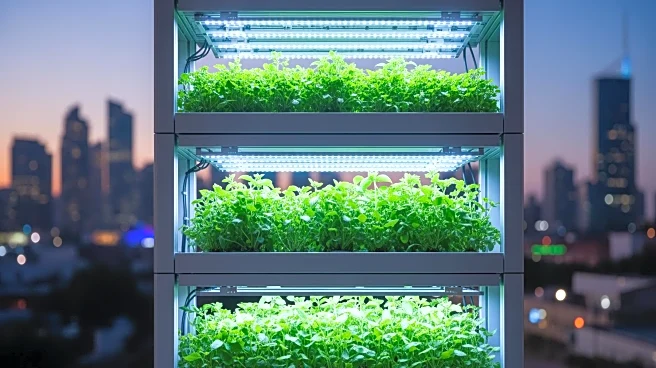
The global vertical farming market is expected to grow significantly, quadrupling from $8 billion in 2025 to $39.7 billion by 2032, according to a report by Maximize Market Research. Vertical farming involves growing crops in stacked layers, often using water-based systems instead of soil. This method is particularly popular in urban areas where space is limited and real estate costs are high. North America, especially the U.S. and Canada, is leading this trend due to increasing urbanization and demand for sustainable, pesticide-free produce. The Asia-Pacific region is also experiencing rapid growth, with government initiatives in countries like Singapore, Japan, China, and India promoting expansion. Hydroponic farming is currently the most
common method, but aeroponics, which uses air and mist to deliver nutrients, is gaining popularity due to its efficiency and flavor benefits.
Why It's Important?
The expansion of vertical farming is significant as it addresses several challenges faced by traditional agriculture, such as limited arable land and the need for sustainable food production. By enabling crop growth in urban settings, vertical farming reduces the carbon footprint associated with transporting produce from rural farms to city markets. This method also allows for year-round production, independent of weather conditions, which can enhance food security. However, the technique faces limitations, particularly in growing crops that require extensive root systems or specific environmental conditions, such as grains and root vegetables. Overcoming these challenges through technological innovation could further expand the market and make vertical farming a more viable option for a wider range of produce.
What's Next?
To continue its growth trajectory, the vertical farming industry must invest in technological advancements that can broaden the range of crops that can be economically grown in controlled environments. This includes developing systems that can efficiently manage the specific needs of different crops, such as temperature, humidity, and light intensity. As the market expands, there may also be increased collaboration between technology companies and agricultural producers to enhance the efficiency and sustainability of vertical farming operations. Additionally, policy support and investment from governments could play a crucial role in overcoming current limitations and promoting further adoption of this innovative farming method.