


What's Happening?
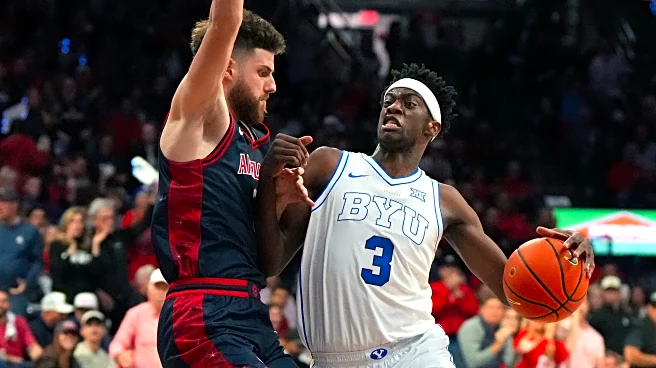
The BYU Cougars secured a significant victory over the Iowa State Cyclones with a final score of 79-69 in a college basketball game held in Provo, Utah. AJ Dybantsa was the standout player for BYU, contributing 29 points, 10 rebounds, and nine assists. This win marks an important achievement for the Cougars, who now hold a record of 20-7 overall and 8-6 in the Big 12 Conference. Iowa State, which was favored by 3.5 points, struggled with their three-point shooting, managing to connect on only 8 of 24 attempts. Tamin Lipsey led the Cyclones with 19 points, while Jamarion Batemon added 14 points off the bench. The Cyclones were coming off consecutive victories against top-ranked teams, including Kansas and Houston, but were unable to maintain
their winning streak against BYU.
Why It's Important?
This victory is crucial for BYU as it enhances their standing within the Big 12 Conference and boosts their confidence as they approach the end of the season. For Iowa State, the loss is a setback in their pursuit of a higher seed in the upcoming NCAA Tournament. The game highlights the competitive nature of college basketball, where rankings and predictions can be overturned by strong performances from underdog teams. The outcome also affects the Cyclones' momentum, potentially impacting their strategy and morale in future games. For BYU, the win could serve as a catalyst for further success, potentially improving their chances of securing a favorable position in the postseason.
What's Next?
Both teams will need to regroup and prepare for their upcoming games as the regular season progresses. Iowa State will likely focus on improving their shooting accuracy and addressing any defensive weaknesses exposed during the game. BYU, on the other hand, will aim to build on this victory and continue their upward trajectory in the conference standings. The performance of key players like AJ Dybantsa will be crucial for BYU as they seek to maintain their competitive edge. The outcome of future games will be pivotal in determining the seeding and matchups for the NCAA Tournament, making every game critical for both teams.