


What's Happening?
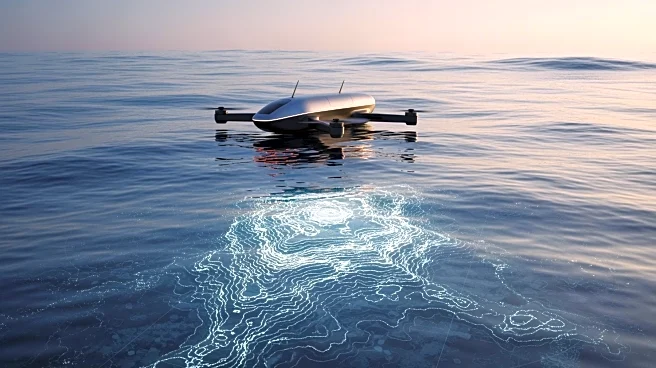
Saildrone has successfully integrated a sub-bottom profiler (SBP) into its Voyager unmanned surface vehicles (USVs), enhancing their capability to image the seabed. This technology was first deployed in the Baltic Sea to support the Danish Ministry of Defence
Acquisition and Logistics Organisation. The Innomar Medium USV SBP provides high-resolution acoustic data, revealing seafloor structures and compositions. This advancement allows for detailed mapping of sediment layers and identification of geological features, crucial for monitoring subsea infrastructure and potential construction sites for wind turbines.
Why It's Important?
The integration of seabed imaging technology into Saildrone's USVs represents a significant advancement in autonomous maritime surveillance. This capability is vital for countries and organizations involved in maritime security, environmental monitoring, and infrastructure development. By providing detailed insights into the seafloor, Saildrone's technology can aid in the protection of critical infrastructure like subsea cables and pipelines. Additionally, it supports the growing offshore wind energy sector by identifying suitable locations for turbine installation, contributing to renewable energy expansion.
What's Next?
Saildrone plans to continue operating its Voyager USVs in the Baltic Sea, with potential expansion to other regions. The company aims to enhance its maritime surveillance capabilities further, possibly integrating additional sensors and technologies. As demand for detailed oceanographic data grows, Saildrone may explore partnerships with governmental and private entities to expand its operational scope. The success of this technology could lead to increased adoption of autonomous systems in maritime applications, influencing future developments in ocean exploration and monitoring.