




What's Happening?
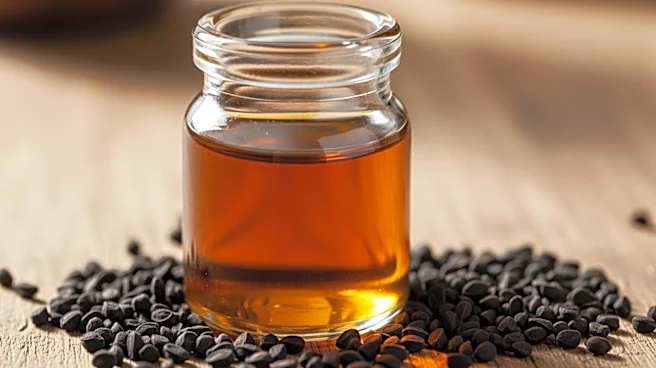
The global black cumin seed oil market is experiencing steady growth, driven by increasing demand for standardized, clean-label botanical ingredients across various applications such as nutraceuticals, wellness, and personal care. According to Future
Market Insights, the market is expected to grow from USD 23.9 million in 2025 to USD 47.9 million by 2036, with a compound annual growth rate (CAGR) of 6.5%. This growth is attributed to a shift from traditional bulk botanical oil usage to specification-driven procurement, emphasizing active compound consistency, particularly thymoquinone. The market's leading segment is liquid oil, which is projected to hold a 44.0% share in 2026, while dietary supplements are the top end-use category with a 41.0% share. E-commerce is emerging as the leading distribution channel, capturing 34.0% of the market in 2026.
Why It's Important?
The expansion of the black cumin seed oil market highlights a broader trend towards functional wellness and preventive healthcare solutions. As consumers increasingly seek products with verified active compound content, the demand for standardized botanical ingredients is rising. This trend is significant for nutraceutical brands, personal care companies, and botanical ingredient suppliers, as it necessitates investment in quality assurance, traceability, and regulatory compliance. The market's growth also underscores the importance of innovation in extraction and formulation processes to meet consumer expectations for clean-label and clinically supported products. As a result, companies that can ensure consistent quality and active compound profiles are likely to gain a competitive edge in premium segments.
What's Next?
The market is expected to continue evolving towards high-value, standardized ingredient systems, with increasing emphasis on quality, traceability, and functional efficacy. Manufacturers are likely to invest in advanced processing infrastructure, in-house testing capabilities, and direct sourcing partnerships to strengthen their competitive positioning. As pharmacy-grade and high-specification retail channels adopt stricter quality benchmarks, suppliers lacking verifiable documentation may face limited access to premium segments. Additionally, the expansion of e-commerce as a distribution channel presents opportunities for brands to reach niche health-conscious consumers and maintain better margins by avoiding retail intermediaries.