







What's Happening?
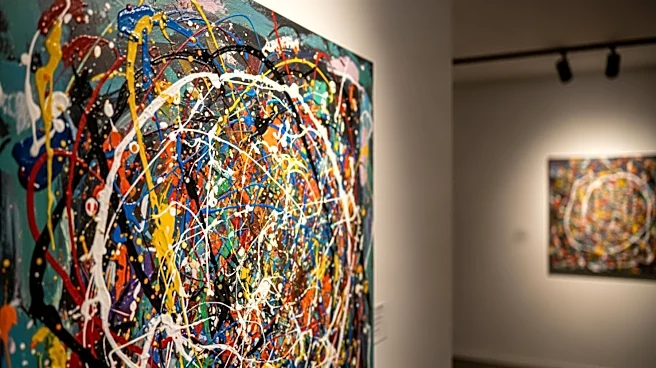
A painting by Jackson Pollock, titled Number 7A, 1948, has been sold for a record $181.2 million at Christie's auction house in New York. This sale marks the painting as the fourth most expensive artwork ever sold at auction, according to ARTnews. The
previous auction record for a Pollock piece was $61.2 million, set in 2021. Christie's described the painting as a significant work where Pollock liberated himself from traditional easel painting, creating one of the first truly abstract paintings in art history. The auction also featured other notable sales, including a bronze sculpture by Constantin Brâncuși, which sold for $107.6 million, and paintings by Mark Rothko and Joan Miró, which fetched $98.4 million and $53.5 million, respectively.
Why It's Important?
The sale of Jackson Pollock's Number 7A for $181.2 million underscores the enduring value and appeal of abstract expressionism in the art market. This record-breaking auction highlights the significant financial investment and interest in modern art, reflecting broader trends in the art world where collectors are willing to pay premium prices for iconic works. The high prices achieved at this auction also indicate a robust market for art, which can have implications for art investors, galleries, and museums. Such sales can influence the valuation of other works by similar artists and contribute to the cultural and economic significance of art as an asset class.
What's Next?
Following this record-breaking auction, there may be increased interest in other works by Jackson Pollock and his contemporaries, potentially driving up prices in future sales. Auction houses like Christie's and Sotheby's may continue to see strong demand for high-value art pieces, prompting them to seek out more rare and significant works for upcoming auctions. Collectors and investors might also look to diversify their portfolios with art, given its demonstrated value retention and appreciation potential. Additionally, museums and galleries may face increased competition to acquire or exhibit such high-profile works, influencing their curatorial strategies and public engagement efforts.