



What's Happening?
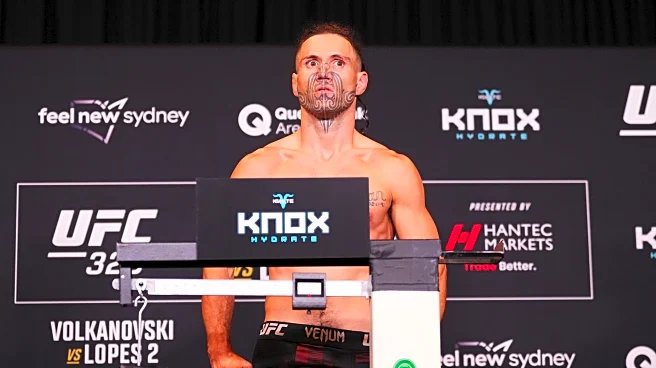
At the UFC 325 weigh-ins in Sydney, Australia, a controversy arose when Aaron Tau, a Road to UFC flyweight tournament finalist, failed to make weight under unusual circumstances. Initially, Tau weighed in at 122.5 pounds, well under the flyweight limit, but after being asked to weigh in again without a box concealing him, he registered at 129 pounds, three pounds over the limit. This discrepancy led to the cancellation of his fight against Namsrai Batbayar. The main event fighters, Alexander Volkanovski and Diego Lopes, successfully made weight for their featherweight championship rematch, with Volkanovski at 144.5 pounds and Lopes at 145 pounds. The co-main event fighters, Dan Hooker and Benoit Saint Denis, also made weight, both at 155.75
pounds.
Why It's Important?
The weigh-in controversy highlights the critical nature of weight management in mixed martial arts, where even minor discrepancies can lead to significant consequences, such as fight cancellations. This incident underscores the importance of transparency and accuracy in the weigh-in process, which is crucial for maintaining the integrity of the sport. The cancellation of Tau's fight not only affects the fighters involved but also impacts the event's schedule and the expectations of fans. For Volkanovski and Lopes, successfully making weight ensures their highly anticipated rematch proceeds, maintaining interest and viewership for UFC 325.
What's Next?
Following the weigh-in controversy, the UFC may review its weigh-in procedures to prevent similar incidents in the future. This could involve stricter oversight and more transparent processes to ensure fairness and accuracy. For the fighters, particularly Aaron Tau, this incident may prompt a reassessment of weight management strategies. Meanwhile, the focus will shift to the main event, where Volkanovski and Lopes will compete for the featherweight title, drawing significant attention from fans and analysts.