
What's Happening?
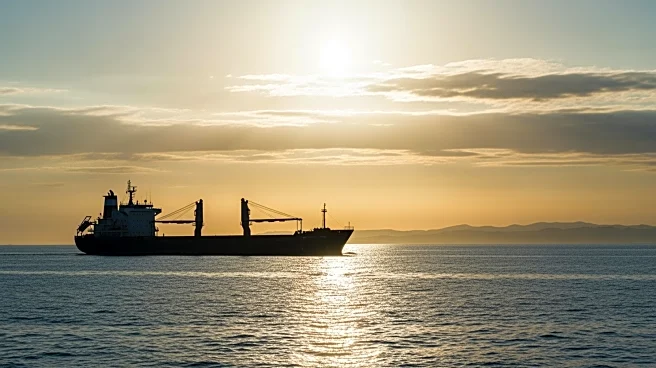
Danish shipping company Maersk has successfully navigated the Red Sea and Bab el-Mandeb Strait for the first time in nearly two years. This move comes as shipping companies consider returning to the critical
Asia-Europe trade corridor. Maersk has stated that while there are no firm plans to fully reopen the route, the company is taking a 'stepwise approach towards gradually resuming navigation' via the Suez Canal and the Red Sea. This cautious return follows a period where Maersk and other companies, such as Germany's Hapag-Lloyd, rerouted vessels around Africa's Cape of Good Hope due to attacks by Yemen’s Houthi rebels. These attacks were reportedly in solidarity with Palestinians in Gaza. The Suez Canal, a vital link between Europe and Asia, previously accounted for about 10% of global seaborne trade.
Why It's Important?
The potential reopening of the Suez Canal route by Maersk could significantly impact the shipping industry, where freight rates have increased due to the longer alternative route around Africa. The recent ceasefire in the Gaza conflict has renewed hopes of normalizing Red Sea traffic, although the truce remains fragile. A return to the Suez Canal could lead to a 10% drop in ship demand, according to Niels Rasmussen, chief shipping analyst at BIMCO. This development is crucial for global trade, as the Suez Canal is the fastest route linking Europe and Asia. The decision by Maersk to test the waters indicates a possible shift back to pre-conflict shipping routes, which could stabilize freight rates and reduce transit times.
What's Next?
While Maersk has completed a test transit with its vessel Maersk Sebarok, no additional sailings are currently planned. The company emphasizes that this does not indicate a broader change back to the trans-Suez corridor. Analysts suggest that any meaningful reopening of the route would likely unfold gradually, with most carriers adopting a wait-and-see approach. The broader resumption of Suez Canal transits could have significant implications for the shipping market, potentially affecting freight rates and shipping demand. The situation remains fluid, with the stability of the ceasefire being a critical factor in future decisions.