
What's Happening?
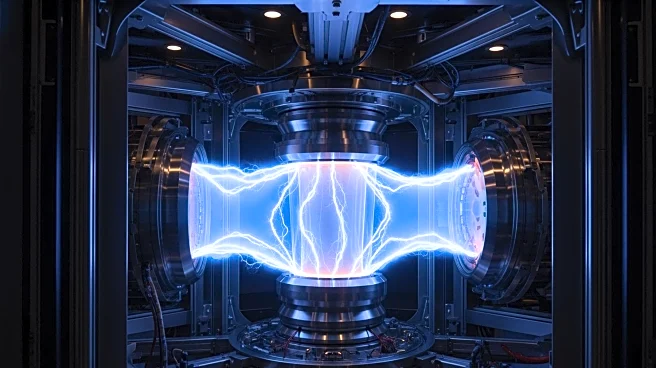
Scientists and companies in the U.S. are making significant strides in the development of commercial fusion energy, a potential 'holy grail' of clean energy. The Massachusetts-based Commonwealth Fusion
Systems (CFS) is at the forefront, utilizing high-temperature superconducting magnets to create smaller and more cost-effective tokamak fusion systems. Their SPARC project aims to pave the way for the first grid-scale fusion power plant, ARC, in Virginia. CFS is collaborating with tech giants like NVIDIA and Siemens to accelerate the development of fusion technology through digital twins and artificial intelligence. This progress is part of a broader global effort, including the ITER project in France, to achieve a net energy gain from fusion reactions, which has long been a challenge.
Why It's Important?
The advancements in fusion energy technology are crucial as they promise a future of limitless, clean energy, which could significantly reduce reliance on fossil fuels and help combat climate change. The development of commercial fusion power plants could transform the power generation sector, providing a sustainable and abundant energy source. This would have profound implications for energy policy, economic growth, and environmental sustainability in the U.S. and globally. Companies like CFS are not only pushing technological boundaries but also setting the stage for a new era of energy production that could support the increasing energy demands of modern technologies, including artificial intelligence and advanced manufacturing.
What's Next?
CFS plans to continue its collaboration with NVIDIA and Siemens to further develop its SPARC fusion machine, with the goal of achieving a commercially viable fusion power plant. The company is also working on scaling its operations and manufacturing capabilities to support the deployment of fusion energy on a larger scale. As these technologies advance, regulatory frameworks and infrastructure will need to adapt to accommodate the integration of fusion energy into the existing power grid. The success of these projects could lead to increased investment and interest in fusion energy, potentially accelerating the timeline for its widespread adoption.