
What's Happening?
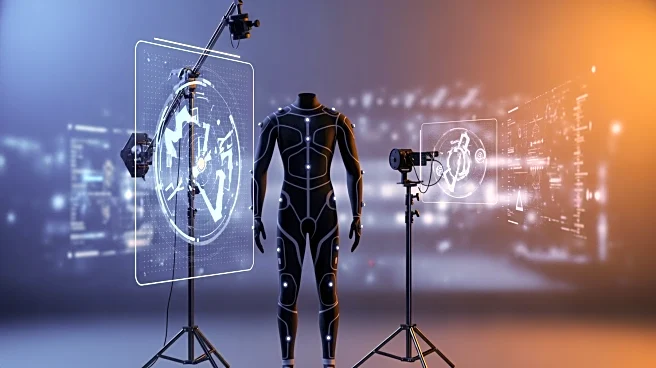
James Cameron, the renowned filmmaker behind the 'Avatar' series, recently discussed the latest installment, 'Avatar: Fire and Ash,' and the role of performance capture technology in filmmaking. The film,
which follows the adventures of Jake Sully and Neytiri, has garnered significant attention, earning $345 million globally in its opening weekend. Cameron highlighted the importance of performance capture, especially in the context of generative artificial intelligence, and expressed his commitment to actor-centric filmmaking. He also touched upon the challenges of meeting box office expectations, given the high production and promotional costs associated with the film. Despite the success of previous 'Avatar' films, Cameron remains cautious about discussing future installments until the current film's financial performance is fully assessed.
Why It's Important?
The discussion around 'Avatar: Fire and Ash' underscores the evolving landscape of filmmaking, where technology and traditional acting intersect. Cameron's emphasis on performance capture highlights the ongoing debate about the role of AI in the film industry. As AI technology advances, there is a growing concern about its potential to replace human actors, which could significantly impact the industry. Cameron's approach advocates for a balance, ensuring that technology enhances rather than replaces human creativity. The financial stakes are also high, as the film's success is crucial for the continuation of the 'Avatar' franchise, which has been a major contributor to the global box office. The outcome of this film could influence future investment in large-scale cinematic projects.
What's Next?
Looking ahead, the performance of 'Avatar: Fire and Ash' at the box office will be closely monitored to determine the feasibility of future sequels. Cameron has plans for 'Avatar 4' and 'Avatar 5,' with tentative release dates set for 2029 and 2031, respectively. A significant portion of 'Avatar 4' has already been filmed, indicating a strong commitment to the franchise. However, the continuation of these projects will depend on the financial success of the current film. Additionally, the industry will be watching how Cameron's use of performance capture and his stance on AI influence other filmmakers and studios, potentially setting new standards for integrating technology in film production.
Beyond the Headlines
Beyond the immediate financial and technological implications, Cameron's work on 'Avatar: Fire and Ash' may have broader cultural impacts. By showcasing the capabilities of performance capture, the film could inspire a new generation of filmmakers to explore innovative storytelling techniques. Moreover, the film's themes and visual storytelling might contribute to ongoing discussions about the environment and indigenous cultures, which are central to the 'Avatar' narrative. As the industry grapples with the ethical use of AI, Cameron's emphasis on preserving the human element in filmmaking could serve as a guiding principle for balancing technological advancement with artistic integrity.