
What's Happening?
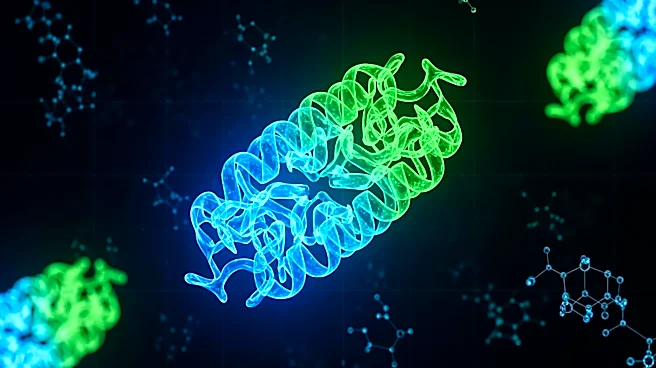
Recent advancements in AI have significantly improved structural biology, particularly in protein binder design and conformational state prediction. The CASP initiative is pushing the boundaries of protein structure
prediction, aiming to model entire conformational landscapes. Microsoft's BioEmu, a biomolecular emulator, is leading this effort by using a generative diffusion framework to sample the Boltzmann distribution of conformations. This approach allows for the prediction of thousands of models, providing insights into stable and alternative protein states. The technology promises to emulate extensive MD simulations in minutes, offering a faster and more efficient method for understanding protein dynamics.
Why It's Important?
These AI advancements are crucial for the field of structural biology, as they enable more accurate predictions of protein behavior and interactions. This has significant implications for drug discovery and development, as understanding protein conformations can lead to more effective therapeutics. The ability to predict and model protein landscapes quickly and accurately can accelerate research and reduce costs, benefiting pharmaceutical companies and researchers. The integration of AI in structural biology also highlights the growing importance of computational methods in life sciences.
What's Next?
The continued development of AI tools like BioEmu will likely lead to further breakthroughs in protein modeling and drug discovery. Researchers may focus on refining these models to reduce biases and improve accuracy. The collaboration between AI and traditional experimental methods will become increasingly important, as it allows for validation and enhancement of predictions. The industry may see increased investment in AI-driven research, with potential collaborations between tech companies and biotech firms.
Beyond the Headlines
The use of AI in structural biology raises ethical questions about data usage and the potential for bias in predictions. As AI models become more prevalent, there will be a need for transparency and accountability in their development and application. The cultural shift towards AI-driven research may also impact traditional scientific practices, requiring adjustments in training and education for researchers.