






What's Happening?
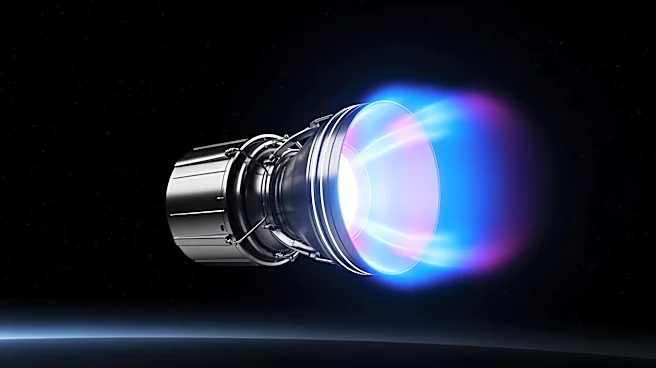
Rocket Lab has announced the addition of a high-performance Hall-effect satellite thruster, named Gauss, to its catalog of space technologies. The company has established a production line capable of manufacturing up to 200 units per year. The Gauss thruster is designed
to offer higher specific impulse compared to traditional chemical propulsion systems, making it more efficient for long-duration missions. This development aims to address the bottleneck in propulsion systems needed for maneuvering spacecraft in orbit, which has been a challenge for commercial and national security space users. The thruster is powered by Xenon, with an option for Krypton, and is ideal for prolonged missions such as deep space exploration and satellite station-keeping within constellations.
Why It's Important?
The introduction of the Gauss thruster by Rocket Lab is significant for the space industry, particularly in the context of proliferated satellite constellations. By providing a more efficient propulsion system, Rocket Lab is addressing a critical need for reliable and scalable solutions in satellite maneuverability. This advancement could enhance the capabilities of commercial and national security space operations, allowing for more efficient use of propellant and extended mission durations. The ability to produce these thrusters at scale may also contribute to the growth of the satellite industry, supporting the increasing demand for satellite services and exploration missions.
What's Next?
Rocket Lab's production of the Gauss thruster is expected to impact the satellite industry by providing a scalable solution for propulsion needs. As the company continues to manufacture these thrusters, it may lead to increased adoption by satellite operators seeking efficient propulsion systems for their constellations. The development could also prompt other companies to innovate and improve their propulsion technologies, fostering competition and advancement in the space sector.