



What's Happening?
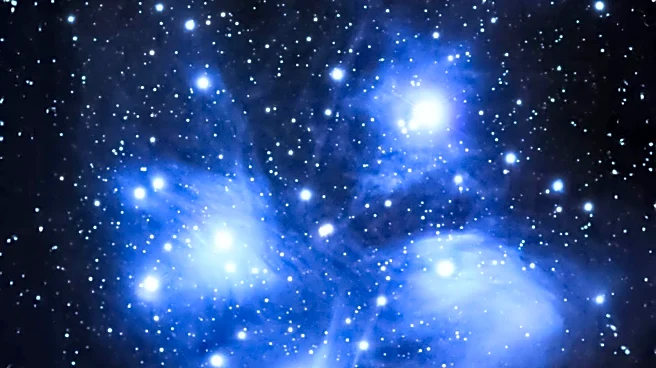
Astronomy enthusiasts are encouraged to observe M67, an open cluster in the constellation Cancer, which is often overshadowed by the more famous Beehive Cluster (M44). M67 is located southeast of M44 and is a 6th-magnitude group of stars, making it an excellent target for beginners with small telescopes. The cluster is approximately 3.2 billion years old and contains around 200 white dwarfs, remnants of Sun-like stars. M67 spans nearly the same area as the Full Moon in the sky, and at least two dozen of its stars are visible through small scopes, with larger telescopes revealing even more stars.
Why It's Important?
Observing M67 provides an opportunity for amateur astronomers to explore a less commonly viewed celestial object, enhancing their understanding of stellar
evolution and the life cycle of stars. The cluster's age and composition offer insights into the history of our galaxy and the processes that govern star formation and decay. Engaging with such astronomical phenomena can inspire interest in science and technology, fostering educational and recreational activities that promote a deeper appreciation for the universe.