






What's Happening?
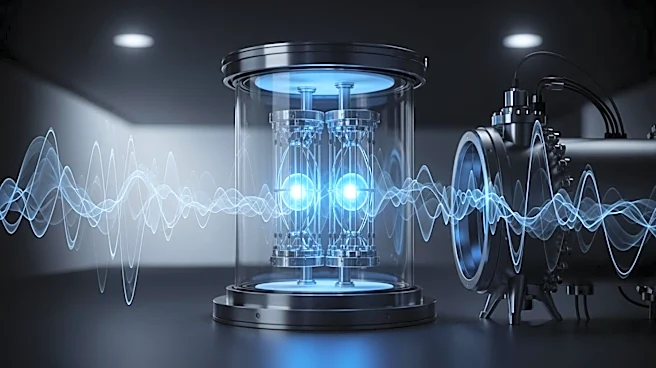
Researchers at the Walther-Meißner-Institute and Technical University of Munich have successfully demonstrated quantum teleportation of microwave states at temperatures up to 4 Kelvin, surpassing classical communication limits. This breakthrough was achieved
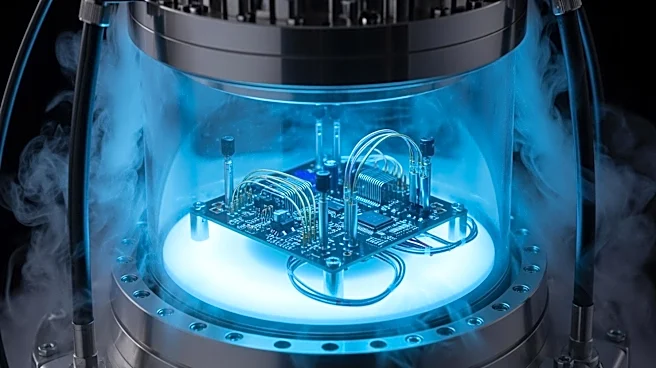
by transferring quantum microwave states between two separate dilution refrigerators connected by a superconducting cable. The study, part of the Quantum Microwave Communication and Sensing (QMiCS) project, highlights the potential for developing large-scale quantum networks that could revolutionize secure communication systems and quantum computing.
Why It's Important?
This advancement in quantum teleportation represents a significant step towards realizing scalable quantum networks, which could transform communication and computing technologies. By enabling the transfer of quantum states at higher temperatures, the research addresses a key challenge in maintaining quantum properties over macroscopic distances. This could lead to the development of more robust and efficient quantum communication systems, potentially paving the way for a quantum internet. The ability to connect remote superconducting quantum nodes could also enhance distributed quantum computing and sensing capabilities.
What's Next?
The research team plans to further develop their system to enable quantum communication at even higher temperatures and over more practical networks. This includes transitioning from rigid millikelvin microwave links to flexible lines cooled by liquid helium. The ultimate goal is to achieve quantum microwave communication at room temperatures and open-air channels, which would align with 5G and 6G standards. Such advancements could significantly enhance the feasibility and application of quantum technologies in real-world scenarios.