




What's Happening?
Salzburg University of Applied Sciences and ABB’s Machine Automation Division, B&R, have collaborated to develop an artificial intelligence system aimed at improving energy efficiency in industrial automation. This partnership, part of the Josef Ressel
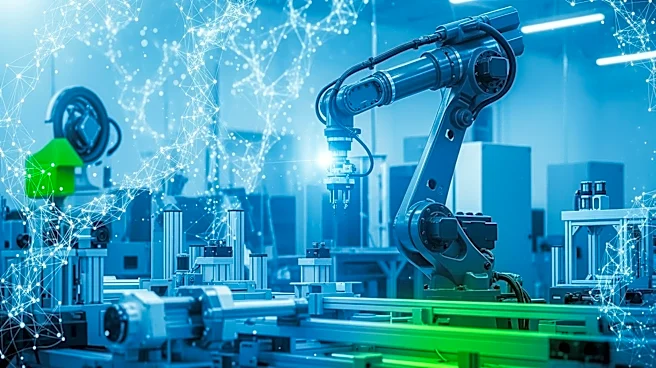
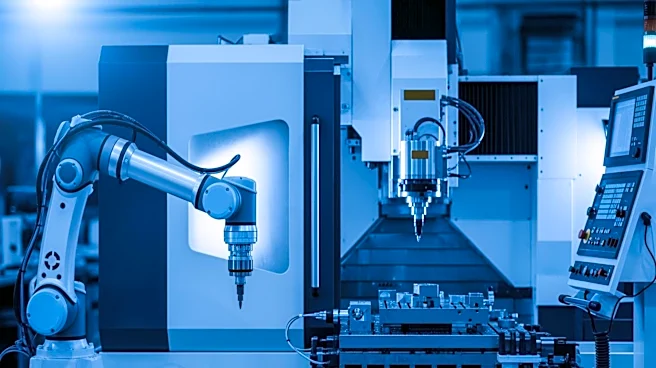
Center for Intelligent and Secure Industrial Automation, has resulted in a joint patent application for energy-optimized motion control in industrial drive systems. These systems are crucial for robots, machine tools, and automated production lines, where precise control of dynamic motion sequences is essential. The innovation leverages reinforcement learning methods, allowing the system to learn from real-world behavior and adapt control strategies to minimize energy losses. This approach overcomes the limitations of traditional control methods that rely on mathematical models, which often fail to account for real-world energy losses.
Why It's Important?
The development of this AI system is significant as it addresses a critical challenge in industrial automation: energy efficiency. By reducing energy consumption in industrial robots and automation systems, the technology can lead to substantial cost savings and environmental benefits. This innovation is particularly relevant as industries worldwide seek to reduce their carbon footprint and improve sustainability. The collaboration between academic research and industrial application exemplifies how scientific advancements can lead to practical solutions that enhance industrial value creation. The successful application of reinforcement learning in this context also demonstrates the potential for AI to revolutionize industrial processes, making them more efficient and sustainable.
What's Next?
The next steps involve further development and potential commercialization of the AI system. As the technology matures, it could be integrated into a wide range of industrial applications, offering companies a competitive edge through improved energy efficiency. Stakeholders, including industry leaders and policymakers, may take an interest in supporting and adopting such innovations to meet sustainability goals. Additionally, the collaboration could inspire further research and development in AI-driven industrial solutions, potentially leading to new patents and technological breakthroughs.
Beyond the Headlines
This development highlights the growing importance of AI in transforming traditional industries. The successful application of reinforcement learning in industrial automation could pave the way for broader adoption of AI technologies across various sectors. It also raises questions about the future of work in industries increasingly reliant on AI, as well as the need for new skills and training for the workforce. Furthermore, the collaboration underscores the value of partnerships between academia and industry in driving innovation and addressing complex challenges.