





What's Happening?
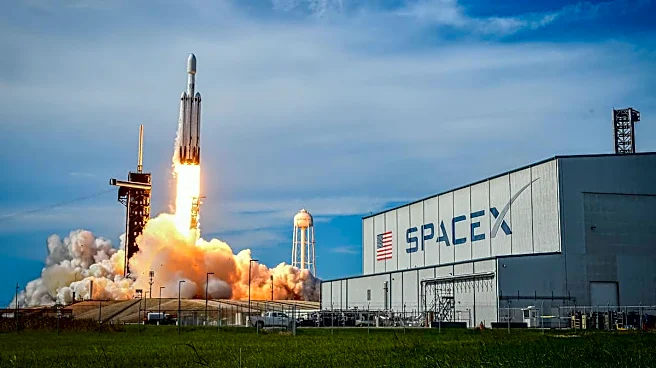
SpaceX, led by Elon Musk, is preparing for a record-setting initial public offering (IPO) with plans to raise $75 billion at a valuation of $1.8 trillion. The company, known for its Starlink satellite network, is set to begin trading on the Nasdaq under
the ticker SPCX. Despite its ambitious goals, SpaceX reported $4.9 billion in losses last year on $18.7 billion in revenue. Analysts from Morningstar have expressed concerns about the company's valuation, suggesting it is significantly overvalued and estimating its worth at $780 billion. SpaceX has allocated 30% of its IPO shares to retail investors, a much higher percentage than the typical 5% to 10%. This IPO is seen as a significant event for the AI sector, marking a shift from private to public investment.
Why It's Important?
The SpaceX IPO is a pivotal moment for both the company and the broader AI and space industries. It represents a major test for public markets, which have seen limited IPO activity in recent years. The high valuation and significant retail investor participation could set new precedents for future tech IPOs. However, the risks associated with investing in such high-profile IPOs are underscored by historical data showing that early investors often see lower returns compared to market indices. The outcome of this IPO could influence investor confidence in other upcoming tech IPOs, including those of SpaceX's rivals, OpenAI and Anthropic.
What's Next?
Following the IPO, SpaceX's performance on the stock market will be closely watched as an indicator of investor sentiment towards high-risk, high-reward tech ventures. The company's future plans, including ambitious projects like a Mars colony and AI data centers in space, will be critical in determining its long-term success. Additionally, the IPO could impact the strategies of other tech companies considering public offerings, potentially leading to a wave of new IPOs in the sector.
Beyond the Headlines
The SpaceX IPO highlights the growing intersection of space exploration and artificial intelligence, with significant implications for both industries. The company's focus on novel revenue streams, such as orbital computing, reflects broader trends towards integrating AI with space technology. This development could accelerate advancements in both fields, potentially leading to new economic opportunities and challenges. Furthermore, the IPO serves as a referendum on Elon Musk's vision and leadership, testing whether public markets are willing to invest in his ambitious goals.