
What's Happening?
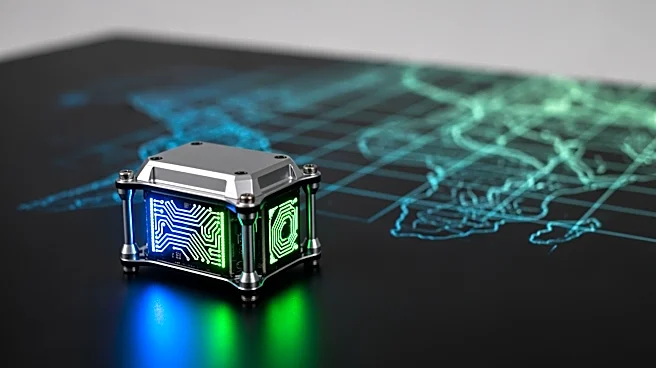
UAV Navigation has launched the VECTOR-300, a high-performance autopilot system designed for use in GNSS-denied environments. This system is engineered to ensure mission continuity in electronic warfare
scenarios by utilizing advanced inertial algorithms and multi-sensor fusion to resist jamming, spoofing, and meaconing. The VECTOR-300 supports AI-based target identification and optical data integration, allowing for real-time trajectory adaptation during missions. It builds on the existing VECTOR autopilot family, offering capabilities such as autonomous mission execution, swarming, and formation flight. The system is designed for large-scale manufacturing, addressing the industrial requirements of unmanned aerial systems.
Why It's Important?
The introduction of the VECTOR-300 is significant as it addresses the growing need for robust navigation systems capable of operating in environments where GPS signals are compromised. This development is crucial for military and defense applications, where electronic warfare can disrupt traditional navigation systems. By providing a reliable alternative, UAV Navigation enhances the operational capabilities of unmanned aerial systems, ensuring they can perform effectively in contested environments. This advancement also aligns with global defense strategies that prioritize scalable and resilient solutions for modern unmanned systems.
What's Next?
The VECTOR-300 is expected to be showcased at industry events, such as Xponential 2026, where UAV Navigation will demonstrate its capabilities. The system's open and modular architecture allows for integration with third-party platforms, potentially leading to collaborations with other defense and aerospace companies. As the demand for GNSS-independent navigation systems grows, UAV Navigation may expand its product offerings to include additional features and capabilities, further solidifying its position in the defense technology market.