









What's Happening?
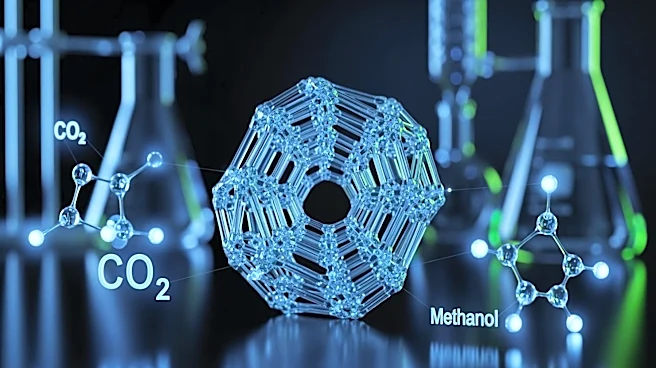
Researchers from the Dalian Institute of Chemical Physics at the Chinese Academy of Sciences have developed a new catalyst design that significantly improves the conversion of carbon dioxide (CO2) into methanol. This breakthrough addresses a long-standing
challenge in the field, where the trade-off between catalytic activity and selectivity has limited methanol yields. The new catalyst employs a strong metal-support interaction (SMSI)-driven overlayer structure, which spatially separates active sites within the catalyst. This design allows different reaction steps to occur in distinct locations, enhancing the efficiency of methanol production. The team achieved a space-time yield of 1.2 grams per gram of catalyst per hour at 300°C and 3 MPa, which is approximately three times higher than conventional commercial catalysts.
Why It's Important?
This development is significant as it offers a more efficient method to recycle carbon resources by converting CO2 into methanol, a valuable chemical feedstock and fuel. The ability to increase methanol production from CO2 could have substantial implications for reducing greenhouse gas emissions and advancing sustainable energy solutions. By improving the selectivity and efficiency of the conversion process, this catalyst design could lead to more cost-effective and environmentally friendly industrial applications. The reduction in carbon monoxide byproducts also enhances the overall sustainability of the process, making it a promising advancement in the field of green chemistry.
What's Next?
The next steps for this research could involve scaling up the catalyst design for industrial applications and further optimizing the process for commercial viability. Researchers may also explore the potential for integrating this technology into existing CO2 capture and utilization systems. Additionally, the scientific community might investigate other applications of the SMSI-driven overlayer structure to improve catalytic processes in different chemical reactions. The success of this catalyst could inspire further innovations in the field of carbon recycling and sustainable energy production.
Beyond the Headlines
The development of this new catalyst not only addresses technical challenges in methanol production but also highlights the importance of interdisciplinary research in advancing sustainable technologies. The collaboration between chemists and engineers in designing and testing the catalyst underscores the need for integrated approaches to tackle complex environmental issues. This breakthrough could also stimulate policy discussions on supporting research and development in green technologies, potentially influencing future regulations and incentives for carbon capture and utilization.