
What's Happening?
Technology group Wärtsilä has introduced a new ship-handling simulator, NTPRO 7, designed to support maritime training as the industry transitions towards digital navigation and more complex vessel operations.
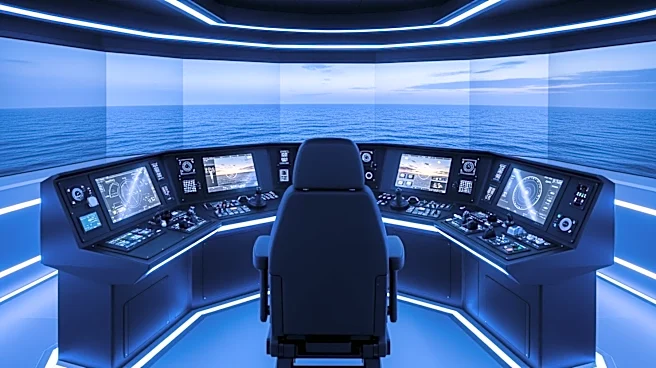
The simulator offers immersive training environments for ship-handling, navigation, and decision-making across various operational scenarios. It features RealSea visualization powered by Unreal Engine 5, an advanced sound system, and new conning and overhead displays that replicate onboard systems. Additionally, it includes S-100 ready digital navigation training using Wärtsilä Navi-Sailor, an electronic chart display and information system. The platform also incorporates a Virtual Watchkeeper with AI-powered voice command recognition and tools for training in wind-assisted propulsion systems. Wärtsilä has received a Statement of Compliance from DNV, confirming the simulator's suitability for navigation training. The platform will be commercially available from May 2026 after a two-year testing and validation phase.
Why It's Important?
The launch of Wärtsilä's NTPRO 7 simulator is significant as it addresses the evolving requirements of maritime training in response to advancements in vessel technologies, digital navigation standards, and regulatory expectations. By providing a future-ready simulation environment, the platform helps training institutions and academies prepare crews for modern bridge operations, supporting long-term competence development. This development is crucial for the maritime industry, which is increasingly reliant on digital navigation and complex vessel operations. The simulator's ability to offer scalable configurations, from full-mission bridge simulators to classroom-based setups, allows for comprehensive training without physical risk, enhancing safety and efficiency in maritime operations.
What's Next?
With the commercial availability of the NTPRO 7 simulator set for May 2026, maritime training institutions and academies are expected to integrate this advanced technology into their curricula. This integration will likely lead to improved training outcomes and better-prepared crews for the challenges of modern maritime operations. As the industry continues to evolve, further advancements in simulation technology may be anticipated, potentially incorporating more sophisticated AI and machine learning capabilities to enhance training realism and effectiveness.