
What's Happening?
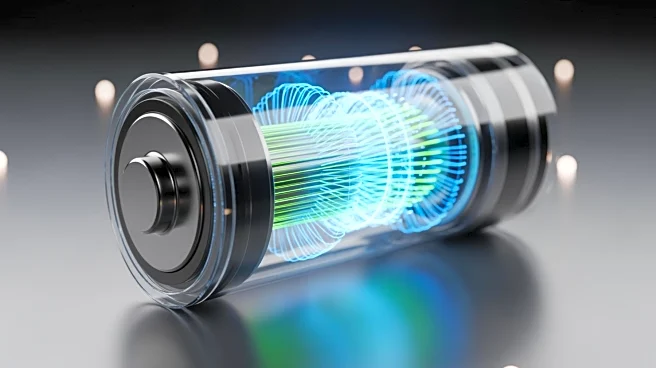
The Council for Scientific and Industrial Research (CSIR) has developed a self-healing rechargeable battery designed to address safety and performance issues associated with traditional batteries. This
innovative battery utilizes a water-based hydrogel electrolyte, which autonomously repairs physical damage such as cuts and cracks, thereby extending the lifespan of electronic devices. The hydrogel polymer, named PHBC-4, forms a reinforced network capable of suppressing zinc dendrite formation, a common cause of short-circuiting and premature failure in conventional zinc-metal batteries. The self-healing hydrogel electrolyte ensures uniform zinc deposition and maintains structural integrity under deformation, recovering up to 93% of its mechanical strength within five minutes. The technology was demonstrated using a flexible pouch cell to power an LED, which continued to function even after intentional damage.
Why It's Important?
The development of self-healing batteries represents a significant advancement in battery technology, offering potential improvements in the safety and longevity of electronic devices. By addressing issues such as dendrite growth and mechanical stress, these batteries could reduce the risk of short-circuiting and extend the operational life of devices, which is crucial for consumer electronics and other industries reliant on battery power. The environmental compatibility and availability of raw materials for zinc-metal batteries further enhance their appeal, potentially leading to wider adoption and reduced environmental impact compared to traditional battery technologies.