






What's Happening?
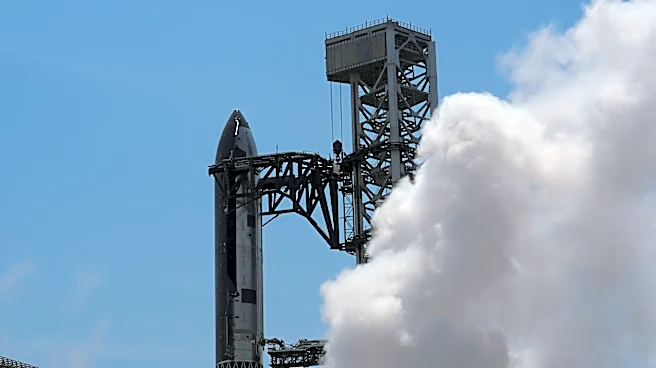
SpaceX is preparing to test a new version of its Starship megarocket, known as Starship V3, which is intended to carry NASA astronauts to the moon. This comes after a series of explosive incidents during previous tests, including a ground test explosion
in June 2025 and a fueling test mishap in November 2025. These incidents have led to emergency responses and public concern in areas near the test sites. Despite these setbacks, SpaceX has achieved some early successes, such as recovering the Super Heavy booster in October 2024. The company is now focused on overcoming the challenges faced with Version 2 of Starship, which experienced explosions during test flights in early 2025.
Why It's Important?
The development of Starship V3 is crucial for SpaceX's ambitions to support NASA's Artemis program and future Mars missions. The success of this rocket is vital for SpaceX's growth, as it plans to use Starship for satellite deployment and orbital AI compute. The company's approach to rapid iterative development, which involves accepting risks during test flights, is a departure from traditional aerospace industry practices. This strategy allows for quicker adjustments and cost-effective design improvements. However, the repeated test failures have raised concerns about safety and reliability, which are critical for gaining regulatory approval and public trust.
What's Next?
SpaceX plans to launch the new Starship V3, which is taller and more powerful than its predecessors, in a test flight aimed at demonstrating its capabilities. The company is under pressure to prove the rocket's reliability, especially as it prepares for an initial public offering. The outcome of this test will be closely watched by investors and stakeholders, as it could impact SpaceX's ability to secure contracts and funding for future missions. Additionally, the company must address regulatory and safety concerns to ensure the rocket can be used for manned missions to the moon and beyond.