



What's Happening?
The global Controlled Environment Agriculture (CEA) market is expected to grow significantly, reaching $271.01 billion by 2032, up from $87.19 billion in 2024. This growth is driven by the adoption of advanced farming technologies that control environmental
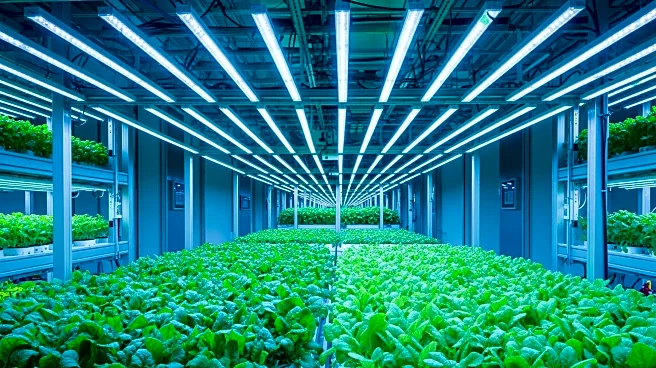
conditions such as temperature, humidity, and light within enclosed structures like greenhouses and vertical farms. These systems allow for year-round crop production, higher yields, and optimized resource use. Key technologies include hydroponics, aeroponics, LED grow lighting, and automated monitoring platforms. North America leads the market with a 35% share, driven by technological adoption and demand for locally produced, pesticide-free vegetables. Europe and Asia-Pacific are also significant markets, with Europe focusing on sustainable agriculture and Asia-Pacific addressing urban food demand and limited arable land.
Why It's Important?
The expansion of the CEA market is crucial for addressing global food security challenges, particularly in urban areas with limited arable land. By enabling year-round production and reducing dependency on weather conditions, CEA systems can improve food supply consistency and quality. The market's growth also reflects a shift towards sustainable agriculture practices, reducing water and pesticide use compared to traditional farming. This trend supports environmental goals and meets consumer demand for fresh, locally sourced produce. However, the high energy consumption and operational costs of CEA systems remain challenges that need addressing to ensure economic viability and scalability.
What's Next?
The CEA market is expected to continue evolving with technological advancements in automation, artificial intelligence, and IoT. These innovations will enhance precision in environmental control, further improving productivity and resource efficiency. Companies are likely to focus on reducing energy consumption through energy-efficient technologies and renewable energy integration. Strategic partnerships and investments in infrastructure will be critical for expanding production capacity and market reach. As urbanization continues, the demand for localized food production systems will drive further adoption of CEA solutions.
Beyond the Headlines
The growth of the CEA market highlights broader implications for the agricultural sector, including shifts towards urban farming and the potential for reducing the carbon footprint of food production. The integration of AI and IoT in agriculture represents a significant technological shift, offering opportunities for data-driven decision-making and improved crop management. These developments could lead to long-term changes in how food is produced and distributed, with implications for supply chain logistics and food security policies.